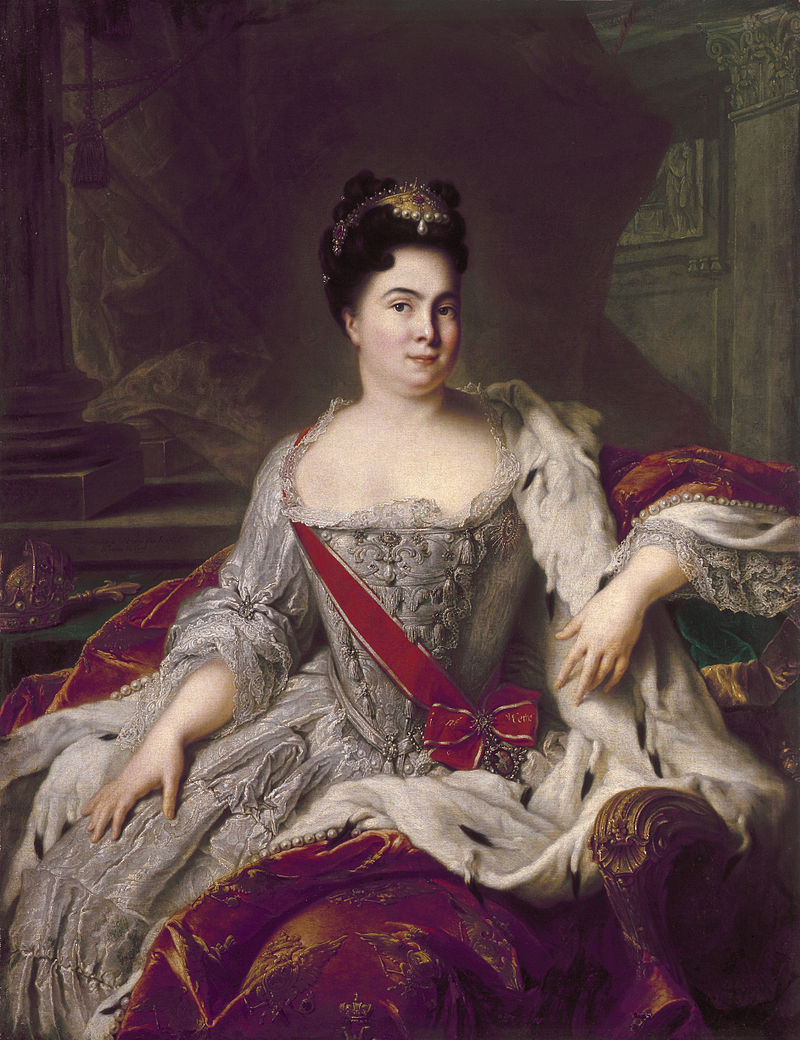
Catherine I
Reign
Russia (1725 – 1727)
Description
Catherine I was born in 1684 as the daughter of a farmer from the Minsk area.
As a young woman, she worked as a servant in many alinhouseholds. It was at this stage of her life that she met the Russian Grand Duke Peter I. In 1705, she converted to Orthodoxy and took a new name: Catherine Alekseevna. They were already married in 1707, but they had to keep it a secret. The official wedding took place in 1712. After that, Catherine was crowned Tsarina, which was a novelty in Russian history.
As Tsarina, she did not care much about the country's problems, but rather spent her time at balls and with her lovers. At that time, she was already struggling with alcoholism and the signs of smallpox were also visible on her face.
She and her husband had 12 children, but only two of them were daughters who reached adulthood.
The first bridges of St. Petersburg were built during her reign.
She died of high fever in 1727. She wanted to nominate her daughter as her successor, but public opinion wanted Pyotr Aleksejevics, the grandson of Peter I, as heir, so the throne went to him, named Peter II.
Minting information
Tsarina Catherine I (1725-1727) used the old Russian currency, the ruble, which consisted of 100 kopecks. The ruble was made of silver, and the kopeck was made of copper. The tsarina's coins bore her own portrait and coat of arms, as well as the mark of the St. Petersburg mint. The reverse side of the coins showed the coat of arms of the Russian Empire and the value of the coins. During the minting of the tsarina, she issued several types of rubles and kopecks, which varied in size, weight and quality. The most common ruble weighed 28.44 grams and was 90% pure, and the most common kopeck weighed 5.1 grams and was 99% pure. During the tsarina's coinage, the ruble was worth an average of 28.8 grams of silver, the kopeck was worth an average of It was 0.051 grams of copper. The tsarina's coinage was not efficient enough to meet the country's growing demand for money, so the tsarina often accepted foreign coins, such as the Swedish thaler, the Polish zloty, or the Dutch guilder.
