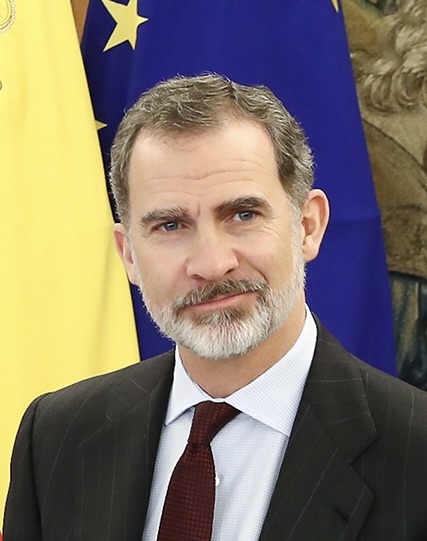
Felipe VI
Reign
Spain (2014 – 0)
Description
Fílöp was born in 1968 during the dictatorship of Francisco Franco, as the third child and only son of the then Prince János Károly of Spain and Princess Zsófia of Greece and Denmark. He officially became Prince of Asturias in 1977, two years after his father became king. He joined the Spanish Army in 1985 to prepare for his future role as Commander-in-Chief of the Armed Forces. After completing his civilian and military studies, he performed various official roles alongside his father. At the press event of one of these events, he met Letizia Ortiz Rocasoláno, whom he married in 2004. They had two daughters: Leonóra and Zsófia. 2014. became the king of the country on June 19, after his father unexpectedly abdicated for health reasons. Already in the first year of Philip's reign, the opinion of the Spanish monarchy improved significantly, and its popularity and acceptance index has been consistently high since its inauguration. Since he took office, the Catalan independence referendum took place - which Fílóp considered illegitimate - which caused a constitutional crisis and led to the dismissal of then Prime Minister Mariano Rajoy.
Minting information
VI. King Philip of Spain's reign began on June 19, 2014, after his father, Charles I, abdicated. The new coins and banknotes introduced during the king's reign are: VI. Coins minted by Philip: 1, 2, 5, 10, 20 and 50 cents: These coins are made of a copper-nickel alloy and have the same size and weight as coins used in other countries of the Eurozone. On the obverse of the coins, VI. It features a portrait of King Philip and the Spanish Royal Coat of Arms on the reverse.€1 and €2: These coins are made of a nickel-copper alloy and are the same size and weight as coins used in other Eurozone countries. On the obverse of the coins, VI. A portrait of King Philip and the Spanish royal coat of arms and the logo of the European Central Bank (ECB) can be seen on the back. Banknotes: 5, 10, 20, 50, 100, 200 and 500 euros: These banknotes are issued by the National Bank of Spain and have the same they are the same size as banknotes used in other eurozone countries. VI on the front of the banknotes. Portrait of King Philip, and bridges, cathedrals and other landmarks of Spain can be seen on the back. VI. Many commemorative coins were minted during the reign of King Philip. These coins are usually made to commemorate historical anniversaries or events. In addition to Spanish, Spanish coins and banknotes are also inscribed in Basque, Catalan, Galician and Valencian. On the edge of the 2 euro coins, in addition to the inscription "2 EURO", the Spanish royal coat of arms is six small The 2-euro commemorative coin minted in 2015 celebrates the 500th anniversary of the Spanish royal family.


