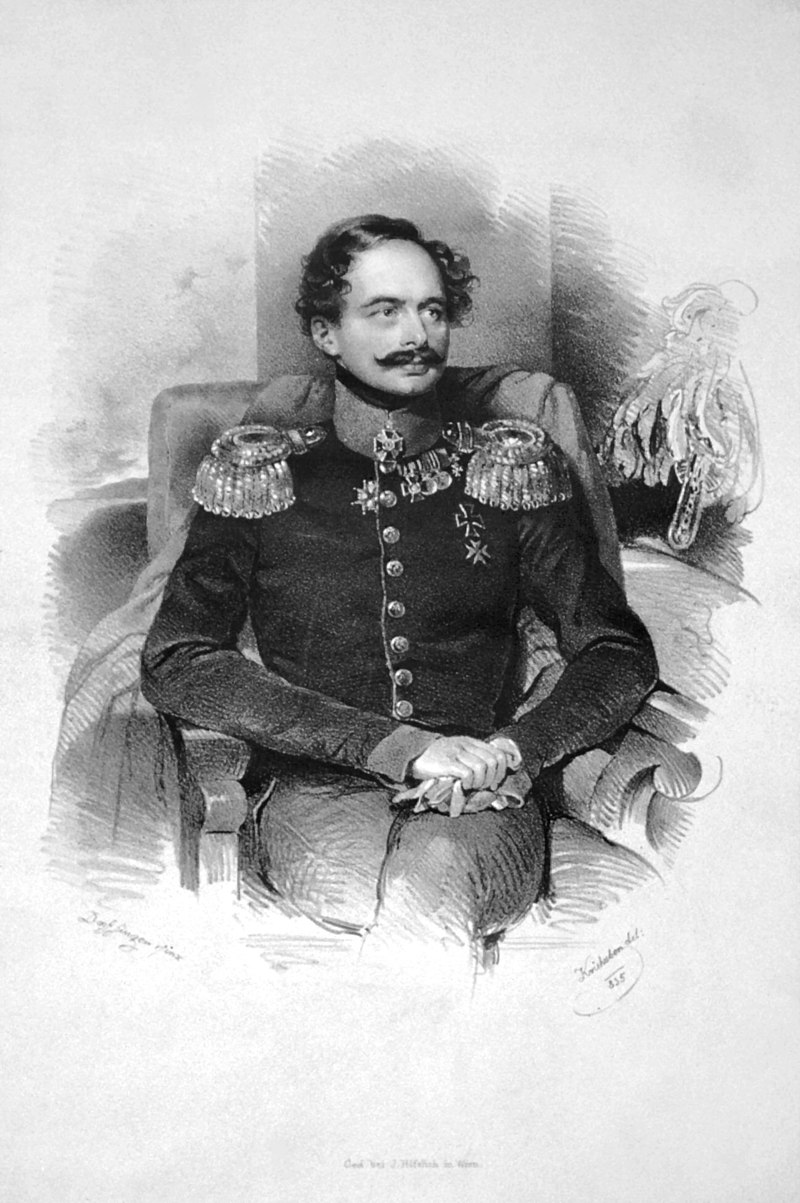
Adolphe
Reign
Luxembourg (1890 – 1905)
Description
Adolf was born on July 24, 1817, in Wiesbaden, as the third child and eldest son of Prince William of Nassau (1792–1839) and his first wife, Lujza of Saxe-Hildburghausen. He was the last prince of the Duchy of Nassau and the first Grand Duke of Luxembourg, which became independent from the Netherlands. Adolf's half-sister, Zsófia II of Nassau. She married King Oskar of Sweden. After the death of his father, Adolf became the ruler of the Duchy of Nassau in 1839, at the age of only 22. The capital of the small duchy was then Wiesbaden, and Adolf moved into the newly completed Stadtschloss. In 1848, the Spring of the Peoples reached Nassau as well, and the duke was forced to accept the "nine demands" of the people of Nassau. A few years later, however, he abandoned his liberal policies and governed with conservative and even reactionary methods. Nevertheless, he was a popular ruler. In the Austro-Prussian War of 1866, he supported Austria, but after the Austrians lost, Prussia annexed Nassau, and Adolf lost his throne. On January 31, 1844, Adolf married Grand Duchess Yelizaveta Mikhailovna Romanova, the niece of Tsar Nicholas I of Russia, in St. Petersburg. just a year later, she died while giving birth to her premature baby girl. Adolf Erzsébet had a spectacular funeral church built for his wife from her one million ruble dowry. 1851. On April 23, he married Mária Adelhaid of Anhalt-Dessau. They had five children, two of whom reached adulthood: Vilmos Sándor (1852–1912), IV. Vilmos Pál Frigyes (September 23, 1854 – October 23, 1855) Mária Bathildis Vilma Charlotte (November 14, 1857 – 1857) December 28.) Ferenc József Vilmos (January 30, 1859 – April 2, 1875) Hilda Charlotte Vilma (1864–1952), married II. To the Grand Duke Frederick of Baden (1857–1928). Adolf's niece, Emma of Waldeck-Pyrmonti, married Adolf III. To King William of the Netherlands and the Grand Duke of Luxembourg. Vilmos died in 1890, and the Dutch throne was inherited by his minor daughter Vilma with Emma. However, Luxembourg, which was in a personal union with the Netherlands from 1815, did not allow inheritance by daughters based on the Franconian law. According to the rules of succession of the rulers of Germany, the Grand Duchy of Luxembourg passed to Adolf, although he was only the 17th cousin of the deceased Vilmos on the paternal side. Shortly before Vilmos's death, during his serious illness, Adolf managed the affairs of the Grand Duchy as regent. He himself was already 73 years old at the time of his coronation and knew little about Luxembourg's internal affairs, so he did not interfere in daily politics, rather he was only nominally the ruler of the country. In 1902, Adolf officially appointed his eldest son, Vilmos, as his successor. He died in 1905 in his summer castle in Germany, Schloss Hohenburg in Lenggries. In 1953, his remains were transferred to the chapel of the castle in Weilburg.
Minting information
Grand Duke Adolf ascended the throne in 1890 and ruled until his death in 1905. During this period, the Luxembourg mint showed significant changes. At the beginning of the reign of Grand Duke Adolf, the mint minted mainly silver coins, only a small amount of gold coins. Among the silver coins, the most frequently minted were 25 and 50 centimes, but also 1, 2, 5 and 10 centimes in smaller quantities. Among the gold coins, the 20-franc one was the most common, but 10, 50 and 100 francs were also minted in smaller quantities. During the reign of the Grand Duke, the mint started minting gold coins in larger quantities. This can be explained by the fact that the Grand Duke tried to make Luxembourg money competitive on the international market. During the reign of Grand Duke Adolf, the mint also introduced the 100-franc gold coin. It was the first Luxembourg gold coin to feature the portrait of the Grand Duke. During the reign of the Grand Duke, the mint introduced many new technologies. The most important of these were the mechanization of minting and engraving work. During the reign of Grand Duke Adolf, the Luxembourg mint underwent significant development. The mint tried to make Luxembourg money competitive on the international market and introduced many new technologies. Coins minted during the reign of Grand Duke Adolf are still highly prized collector's items.