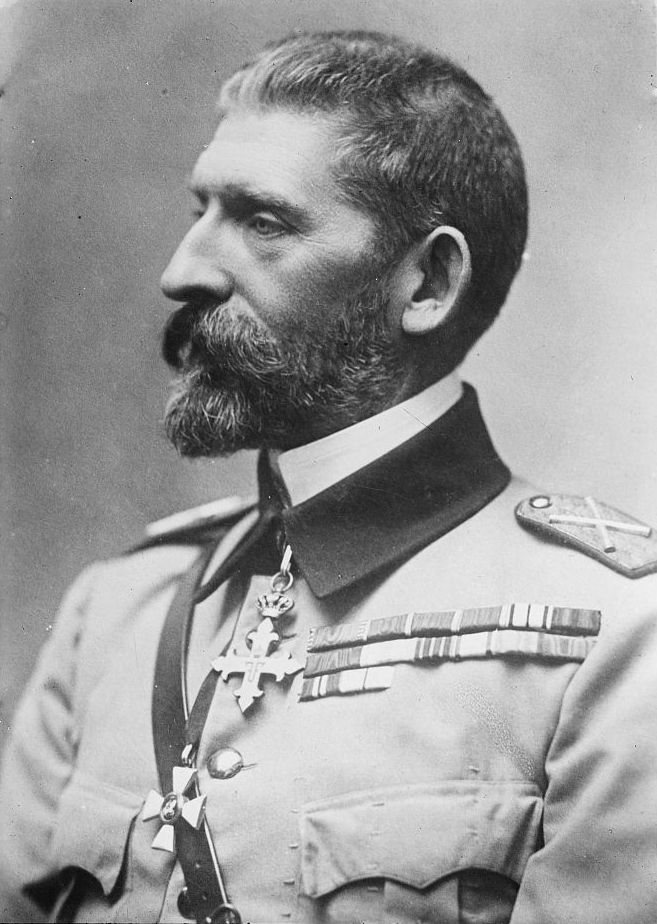
Ferdinand I
Reign
Romania (1914 – 1927)
Description
King Ferdinand I of Romania (German: Ferdinand Viktor Albert Meinrad von Hohenzollern-Sigmaringen) was born on August 24, 1865 in Sigmaringen. His father, Prince Leopold von Hohenzollern-Sigmaringen, and his uncle, King Charles I of Romania, adopted him in 1889, so Ferdinand became the heir to the throne of Romania. In 1893, he married Maria, Princess of Edinburgh, British Queen Victoria and II. Grandson of Tsar Alexander of Russia. Although he was a reticent and sometimes hesitant man, he was thoroughly informed in Romania's military affairs and himself commanded the army in the Second Balkan War. When his uncle died, he succeeded him on the throne of Romania on October 10, 1914. At the beginning of the First World War, it took a wait-and-see position before permanently joining the Entente in August 1916. The German response did not take long: at the end of the year, the Romanian capital, Bucharest, also fell into German hands, and the king's government fled to Iași. The rapid advance of the occupying forces demoralized the Romanian army, so in April 1917 he promised the Romanian soldiers land reform. In doing so, he avoided the development of a revolutionary situation, but he provoked a problem that the post-war governments were never able to fully solve. Romania was forced to lay down its arms to the troops of the Central Powers in March 1918, but it rejoined the Entente in November. Transylvania, Bukovina, part of Bánság and Bessarabia were annexed to Romania during the peace treaties that ended the World War, thus doubling the territory of the kingdom, and in October 1922, Ferdinand was crowned king of the country in Gyulafehérvár. In 1920, Ferdinand carried out a royal coup d'état and installed General Alexandru Averescu as prime minister. In 1921, his government implemented the long-promised land reform of the king. In 1925, Ferdinand forced his son, the profligate heir to the throne Károly, to renounce his rights to the throne, and later, by the king's will, his young grandson, Prince Mihály, inherited the throne. He died on July 20, 1927 in Sinaia.
Minting information
The reign of Ferdinand I (1914-1927) fell on an extremely turbulent period in Romania's history, full of war, territorial changes and economic challenges. The coinage in this period reflects the events of the era and provides insight into the changes in the Romanian economy and society. At the outbreak of the First World War, Romania was not yet ready for modern warfare. The army was poorly equipped and most of the weaponry was imported. This situation also affected the coinage. In 1914, the Romanian mint minted gold and silver coins, but due to the economic difficulties caused by the war, the gold and silver coinage was stopped in 1916. From 1917, the mint printed paper money to cover the war expenses. Paper money inflation rose rapidly, leading to economic instability. After World War I, Romania acquired significant territories, including Transylvania, Bukovina, and Bessarabia. This increase in territory brought with it a boom in the Romanian economy. In 1922, the leu was introduced as Romania's new national currency. The lei was initially pegged to gold, which provided stability to the economy. In the 1920s, the Romanian mint minted gold and silver coins again, but their quantity was significantly smaller than in the pre-war period. Coins and banknotes in circulation: gold coins: 20 lei (1914), 100 lei (1914), silver coins: 1 lei (1914), 5 lei (1914). Paper money: 1 lei (1917), 5 lei (1917), 10 lei (1917), 50 lei (1917) , 100 lei (1917).I. During the reign of Ferdinand, the Romanian coinage reflected the historical and economic events of the era. The difficulties caused by the war resulted in a decline in coinage, while the recovery after the war led to the introduction of the lei and the stabilization of the economy.
Romania Ferdinand I (1914-1927) 2 Lei Coin
Available: 2 pcs (1 seller)
300 Ft – 900 Ft

Romania Ferdinand I (1914-1927) 25 Bani Coin
Available: 1 pcs (1 seller)
3 900 Ft

Romania Ferdinand I (1914-1927) 1 Lei Coin
Available: 2 pcs (1 seller)
200 Ft – 300 Ft

Romania Ferdinand I (1914-1927) 50 Bani Coin
Available: 1 pcs (1 seller)
500 Ft