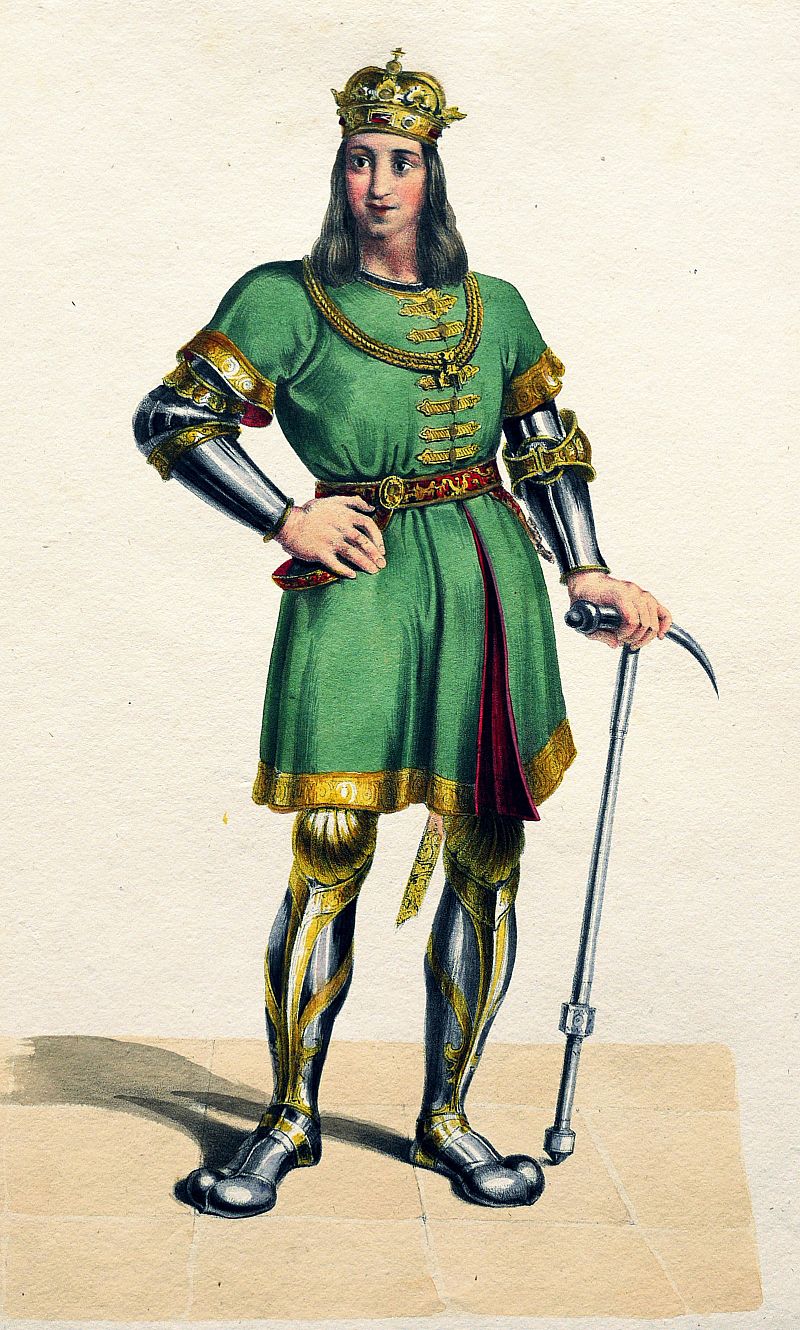
Ladislaus IV the Cuman
Reign
Hungary (1272 – 1290)
Description
ARC. (Kun) László, the Hungarian king of the Árpád House, ruled between 1272 and 1290. His father was King István V, his mother was Princess Erzsébet Kun. In his certificates, László Kun identified himself as III. He called him László, because II. László, the III. The counter-king who appeared during István's time was not recognized as a legitimate ruler at that time. However, the name Kun was not given to him because of his mother's origin, but was given to him during his lifetime. The power-hungry lords, led by Joachim bán, kidnapped him as a child in order to keep his father in check. László, who ascended the throne, was still at the mercy of the lords, and this greatly contributed to the fact that, when he grew up, he preferred to be with his "beloved kunjas" than among the Hungarians. He almost completely identified with them, adopting their lifestyle and customs. Due to the struggle between his father and grandfather, László witnessed and even suffered from many acts of violence, which certainly affected his later personality. Although IV. King Béla and István V the Younger made peace in Bratislava in the very year of László's birth, and in 1264 the conflict between the two parties turned into an armed conflict again. The barely two-year-old László and his mother were captured by his own grandfather in Sárospatak and imprisoned in the castle of Turóc. In March 1265, in the battle of Isaszeg, István V finally won a decisive victory over IV. Over Béla's army. The civil war ended on March 23, 1266 on Nyulak Island (today's Margit Island), and László was freed. However, with the conclusion of the Nyulak Island Peace, the division of the country did not end, and this accelerated the growth of large estates and the dramatic decline of royal authority. Loyalty was divided, exchangeable and had to be bought with property donations. László's father pursued an independent foreign policy after 1265. In 1269, László engaged the daughter of King Charles I of Sicily (younger brother of King Louis IX of France), Izabella (who was called Elizabeth in Hungary), and the girl was brought to Hungary in 1270. The official marriage was only concluded a few years later (only in 1276 at the earliest), when the parties reached the age required for this according to church law: Elizabeth was 12, László was 14. This kind of political marriage of children was typical of the Middle Ages. IV. (Kun) László died at the age of 27 on July 10, 1290 in Körsözge, and his resting place is in the Csanád Cathedral, Csanád.
Minting information
ARC. During the reign of László (1272–1290), several types of coins were minted in Hungary. The most common coin was the denarius. This copper coin depicted the coat of arms of the House of Anjou, the lily, and the king's name and title. There were several versions of the denarii, where they differed in the details of the coat of arms and inscriptions. The obulus was a tenth of a denarius and was often used for small transactions. Obulus were generally smaller in size and of lower value than denarii. ARC. During Laszlo's reign, the coinage underwent various changes and the coins varied in terms of coat of arms, inscriptions and value.