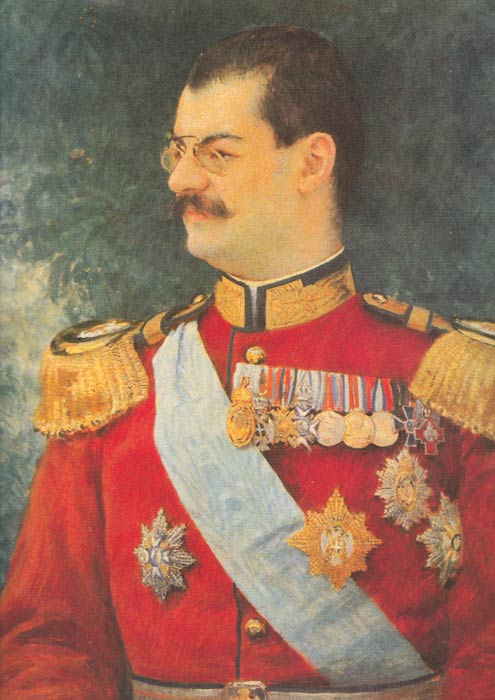
Alexander I
Reign
Serbia (1889 – 1903)
Description
Sándor Obrenović I (Belgrade, August 14, 1876 - Belgrade, June 11, 1903) Serbian king from 1889 until his death.I. He was born as the only child of Serbian King Milan, and after his father's abdication in 1889, he ascended the throne as a child, so to speak. A council of regents was appointed alongside him, which Sándor dissolved in 1893, and at the age of 17 he took control of the country himself. The young man, who was still favorably received when he ascended the throne, soon turned most of his supporters against him, as he excluded the pro-Russian Radical Party from the government, and instead of the liberal constitution of 1889, he revived the basic law of 1869, which limited legislation. He often changed his ministers and called him home, then appointed his father, a pro-Austrian exile living in exile, as commander-in-chief of the army. It restricted freedom of association and freedom of the press. The unsuccessful assassination attempt against Milan I in 1899 led to further repressive measures. In 1900, Sándor permanently lost his authority in front of his subjects when, ignoring the objections of his father and political advisers, he announced that he would marry Draga Mašín, who was ten years older than him. the widow of a Czech engineer who used to be a courtesan of Milan. After the decision, the Serbian government resigned in protest. Due to the scandal, in 1901, Sándor was forced to introduce a more liberal constitution and created the senate (the upper house of the legislature). During the king's reign, he developed the economy, reformed the army, and tried to improve Serbia's international position by reviving the Balkan alliance originally named after Prince Mihály. At the same time, he made a mockery of constitutional government, also planning to appoint Draga's brother as his heir. During the May coup, a group of conspirators stormed the palace and massacred Sándor, Draga, and several members of their court. The majority of the people welcomed the coup d'état, and the new king became Péter I. Karagyorgyevics, the son of the Serbian prince Sándor, who resigned in 1858.
Minting information
During the reign of Alexander I (1889–1903), Serbia underwent major coinage reforms. In 1890, the gold dinar was introduced, worth 1 dinar = 5 francs. This currency was made up of the following coins: 1 dinar silver, 2 dinar silver, 5 dinar silver, 10 dinar gold. In 1893, nickel 5 and 10 paras coins were introduced, and in 1900, bronze 1 and 2 paras coins were introduced.I. Characteristics of Serbian coins during Alexander's reign: The portrait of King Alexander I was on the obverse of the coins, the Serbian coat of arms was visible on the reverse, and the inscription was in Serbian.I. King Alexander's reign ended with his assassination in 1903. However, the coinage reforms he introduced remained in place and became cornerstones of Serbia's financial stability."


