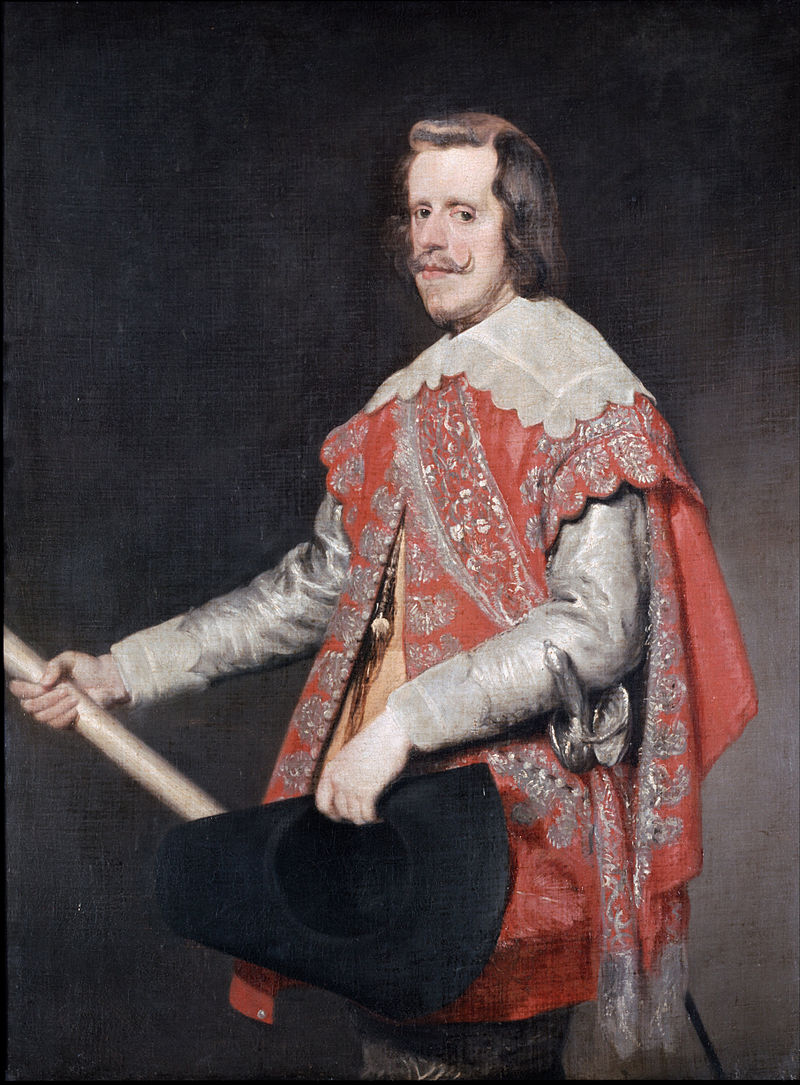
Philip IV
Description
ARC. Philip, popularly known as Philip the Great or "Planet King", was king of Spain from 1621 until his death in 1665. He was the last Habsburg to hold the title of King of Portugal (as Filipe III in Portuguese) until his abdication in 1640. His reign of more than forty-four years is the third longest reign in Spanish history. It was Philip III. He is the eldest son of King Philip of Spain, who was born to his second cousin Margaret of Austria. During his reign, he was a great patron of Spanish arts, becoming a patron of such well-known artists as Diego Velázquez. By the end of his reign, his empire covered 4.7 million square miles. However, his country began to decline in other respects: it was during his reign that the Thirty Years' War took place, in which Spain fought on the side of the German-Roman Empire and the Catholic League, which meant serious expenses and deepened the conflict situation with neighboring France, and it was under his rule that Spain won its independence Portugal. Philip was married twice, only three of his children reached adulthood. His first wife was the French royal princess Elizabeth from the Bourbon branch of the Capeting house. As Queen Elizabeth, she already used the Spanish equivalent of her name, i.e. Izabella. She herself was the second and eldest daughter of King Henry the Great of France and Maria de' Medici, Grand Duchess of Tuscany. Their marriage took place on 25 November 1615 in Bordeaux. A total of eight children were born from their relationship, but only one of them, the youngest daughter, reached adulthood. Four years after the death of his first wife on October 6, 1644, on October 7, 1649, at the age of forty, Fílöp married his niece in Madrid, the then fourteen-year-old Austrian Archduchess Mária Anna, III. She was the daughter of the German-Roman Emperor Ferdinand, King of Hungary (his cousin) and Mária Anna of Spain (Philipp's sister), so they were closely related on both the paternal and maternal sides. Mária Anna was originally engaged to her son, the infant Károly Baltazár, but he died in the meantime. Five children were born from the marriage of Fílöp and Mária Anna.
Minting information
ARC. King Philip of Spain and Portugal ruled from 1621-1665. During this time, Spain's finances deteriorated significantly, which also affected the coinage. The debt of the kingdom was increasing and the coinage was used more and more to finance the war expenses. The main mint of the kingdom was in Madrid, but there were also several smaller mints, for example in Toledo, Seville and Valencia. The coins were mainly made of silver and gold. The Spanish coinage was characterized by the following, the quality of the coins gradually deteriorated, the production of the coins became more and more expensive and they became more and more rare. IV. Philip's coinage contributed significantly to the Spanish financial crisis. The deteriorating quality and increasingly rare coins called into question the economic stability of the Spanish crown. Some specific features of the kingdom's coinage are as follows: Among the silver coins, the most frequently minted pieces were the 10 réales, the 8 réales and the 4 réales. Among the gold coins, the most frequently minted pieces were worth 2 escudos, 1 escudos and 1/2 escudos. The obverse of the coins usually featured a portrait of the king, and the reverse featured heraldic motifs. IV. Philip's coinage also had a significant impact in Hungary. The Hungarian mints also dealt with forgery of the kingdom's coins.
No coins linked to this ruler yet.