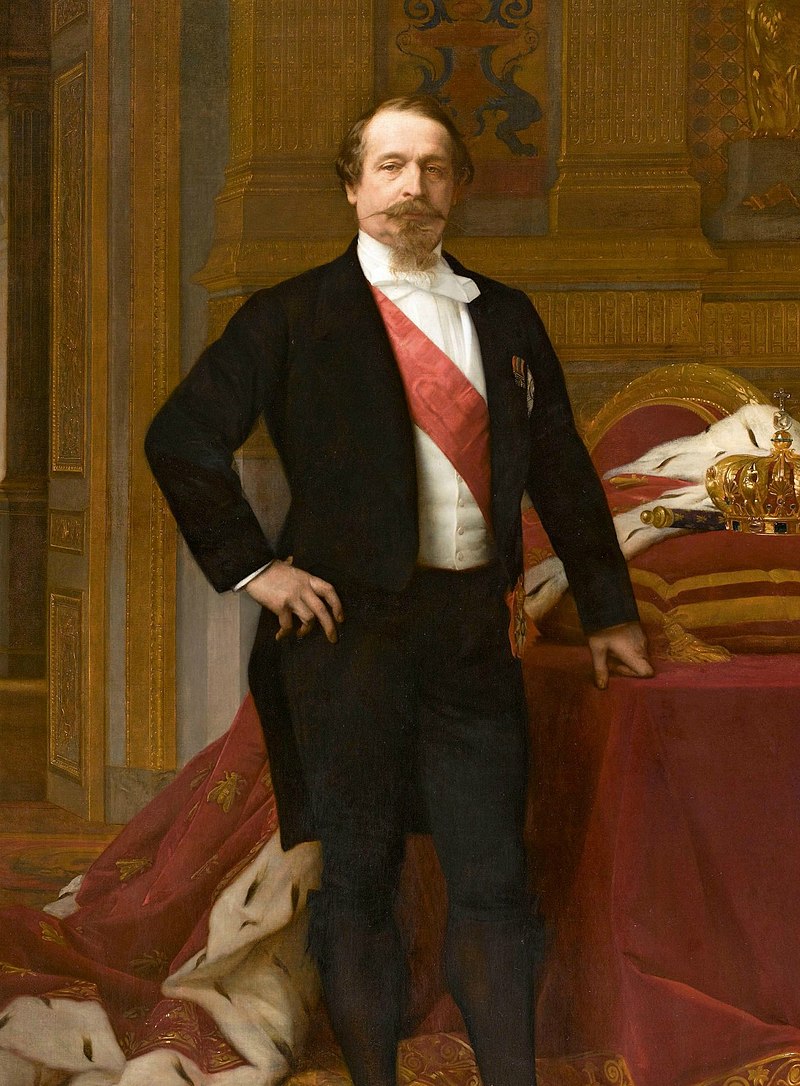
Napoleon III
Reign
France (1852 – 1870)
Description
III. Napoleon, full name Charles-Louis Napoléon Bonaparte, was the emperor of France from December 2, 1852 to September 4, 1870. His political career first began as the president of the French Republic in 1848, and later, in 1852, he crowned himself emperor, thereby establishing the second French empire. III. Napoleon was born on April 20, 1808 in Paris. His father was Louis Bonaparte, the younger brother of Napoléon Bonaparte, who was King of the Netherlands from 1806 to 1810 as Louis I. His mother was Princess Hortense de Beauharnais, the daughter of Empress Josephine and her first husband, Marquis Alexandre de Beauharnais. III. Napoleon experienced several failures in his political career before becoming President of the French Republic in 1848. As president, his efforts included economic modernization, social reforms, and the strengthening of France's international position. In 1851, he carried out a coup d'état and thereby consolidated his power, and in 1852 he declared himself emperor. He renounced the coronation and did not seek to build dynastic relationships: he entered into a love marriage when he married the daughter of a Spanish nobleman, Eugenia de Montijo, in 1853, who gave birth to his only son, Napoléon Eugène Louis, who after his death was succeeded by Bonapartists IV. He was proclaimed emperor under the name Napoleon, although he never ruled. He found a worthy companion in his wife: he discussed political issues with the educated and intelligent Eugénia several times, and appointed her regent three times in his absence (1859; 1865; 1870). An unsuccessful attempt was made against him in 1853. During his reign, France achieved significant territorial expansion and participated in several major conflicts, such as the Crimean War and the wars for Italian unification. Its domestic policy showed signs of liberalization, including through the expansion of press freedom and suffrage. In the economic field, the main goal was the development of the railway network and the banking system. After the defeat in the Prussian-French war, in 1870, III. Napoleon was forced to abdicate. After the humiliating defeat he suffered in the war and the fall of the empire, he went into exile in England, where he died on January 9, 1873 in Chislehurst. III. During the reign of Napoleon, France underwent significant changes, and his name was forever written in history. The French writer Victor Hugo gave him the name "the Little Napoleon" ("Napoleon le Petit"), which also appeared in the Hungarian press of the time.
Minting information
III. During the reign of the French Emperor Napoleon (Napoleon III) (1852-1870), various coins were minted, with varying numbers, coins and materials. The most important coinage events were: 1852-1853: Gold 20-franc coin (Napoleon gold), these were popular gold coins. 1854-1858: Silver 5-franc coin, also known as "Napoleonic gold". 1861-1868: Silver 10-franc coins and 5-franc coins with Napoleon's portrait. 1864: Bronze "Céntimes Napoléon" coins from 1 centimeter to 10 centimes. 1865: Silver 50-franc coins and 20-franc coins. 1870: First silver 5-franc coins and 1-franc coins. Napoleon coin series and values may change over the years. A collection of Napoleonic coins can still be very popular and valuable among coin collectors.

France Napoleon III (1852-1870) 10 Centimes Coin
Available: 12 pcs (1 seller)
500 Ft – 5 900 Ft

France Napoleon III (1852-1870) 5 Centimes Coin
Available: 11 pcs (1 seller)
400 Ft – 2 500 Ft

France Napoleon III (1852-1870) .835 Silver 1 Francs

France Napoleon III (1852-1870) 2 Centimes Coin

France Napoleon III (1852-1870) 2 Francs .835 Silver Coin
France Napoleon III (1852-1870) 10 Centimes Coin
France Napoleon III (1852-1870) 20 Francs .900 Gold Coin 6.45161g
France Napoleon III (1852-1870) 20 Centimes .900 Silver Coin
France Napoleon III (1852-1870) 5 Centimes Coin
France Napoleon III (1852-1870) 2 Centimes Coin
France Napoleon III (1852-1870) 20 Centimes .835 Silver Coin
France Napoleon III (1852-1870) 5 Francs .900 Silver Coin