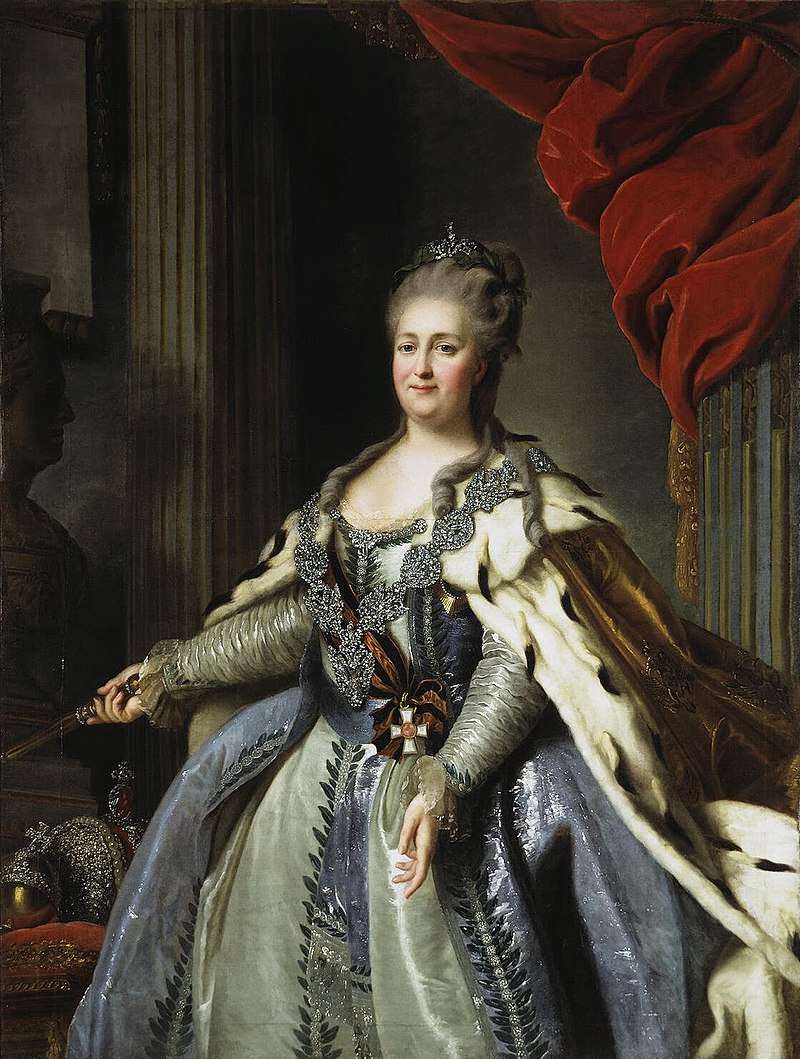
Catherine II the Great
Description
Tsarina Catherine II of Russia, also known as Catherine the Great, was born in Prussia in 1729. As a princess of German origin, her original name was Sophie Friederike Auguste. In 1745, she married Peter III joined the Russian tsar and converted to the Orthodox faith, taking the name Yekaterina Alekseevna. After a coup against her husband in 1762, Catherine crowned herself tsar, and under her rule, until her death in 1796, she carried out significant reforms in Russia. During her reign, she was guided by the ideas of the Enlightenment and supported art, education and the sciences. Among her best-known reforms are the modernization of the legal system and the reorganization of public administration, which were aimed at increasing the efficiency of the state. The tsar pursued an expansive foreign policy, through which Russia acquired significant territories, including the Black Sea coast and during the partition of Poland. This made the country one of the great European powers. During her rule, however, the situation of serfdom did not improve, in fact, it often worsened. After the death of Catherine the Great, her son Pál I ascended the throne. Catherine's reign is considered one of the golden ages of Russian history.
Minting information
II. During the reign of the Russian Tsarina Catherine (1762-1796), Russian coinage underwent significant changes. In order to boost economic development and trade, the Tsarina minted new coins that met European standards. The most important change was changing the weight of the ruble. Instead of the previous 480, the weight was changed to 492.69 grams, which was in line with Western European countries. In addition to the ruble, the rublevka minted from silver and the kopek minted from copper also remained. The tsarina also minted new coins, gold, 1 ruble, 5 ruble, 10 ruble, 25 ruble, 50 ruble, silver 2 ruble, 5 ruble, 10 ruble, 25 ruble, 50 rubles, copper 1 kopek, 2 kopecks, 3 kopecks, 5 kopecks, 10 kopecks, 25 kopecks, 50 kopecks. II. Coins minted by Katalin were also significantly better in their artistic design than those made in the previous period. During the Tsar's reign, Russian minting activity increased significantly, and Russian coins became recognized in Europe. Coins minted by the Tsar are still highly prized by collectors today.

