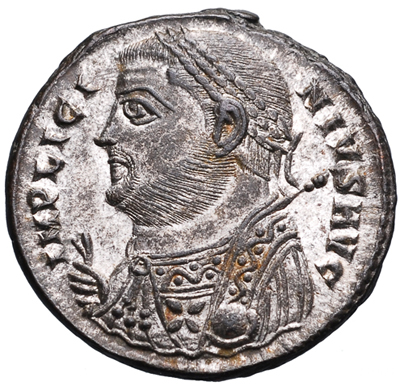
Licinius
Reign
Roman Empire (308 – 324)
Description
Son-in-law of Constantius Chlorus I. He was abdicated in 323 and then exiled in 325.
AESAR GAIVS VALERIVS LICINIVS AVGVSTVS
Minting information
The coinage of Emperor Licinius is one of the most important numismatic sources of the period of the Roman Empire between 308-324. The political and religious activities of Emperor Licinius, as well as the economic situation of the empire, can be traced on the basis of the coins. Licinius' coinage initially followed traditional Roman patterns. He minted gold aureus, silver denarius and bronze antoninians bearing the emperor's portrait and titles. On the reverse side of the coins, the emperor was often depicted together with goddesses, such as Iupiter or Minerva. In 313, Licinius and Emperor Constantine jointly issued the so-called Edict of Milan, which re-authorized the free practice of religion for Christians in the empire. The coinage of Licinius changed after that, and the symbols of Christianity appeared on the coins. The reverse side of the coins often shows a cross, a lamb's head or the monogram of Christ. In 324, a war broke out between Licinius and Emperor Constantine, in which Licinius was defeated. The emperor was captured and executed by Constantine. Licinius' coinage ended with this.
