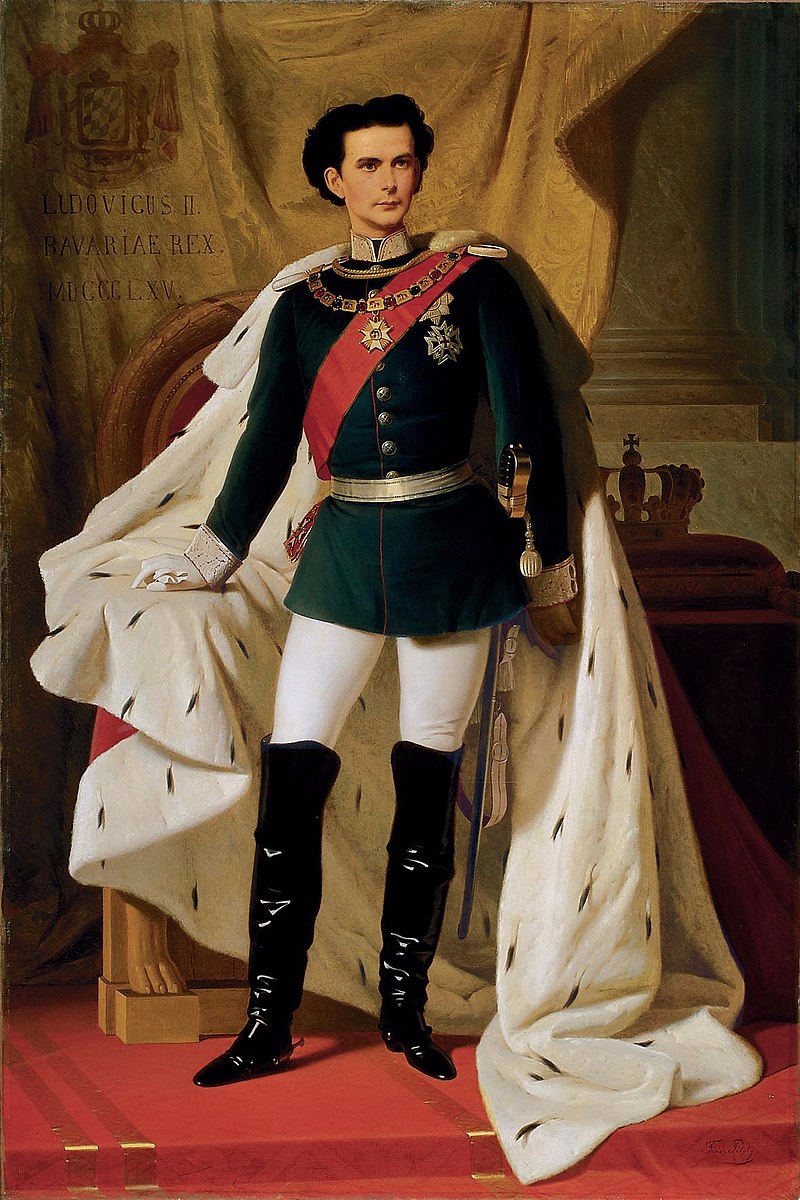
Ludwig II
Reign
German States Bavaria (1864 – 1886)
Description
Ludwig II, known as the “Fairytale King” or “Swan King”, ruled Bavaria from 1864 until his tragic death in 1886. His reign was not known for his military or political successes, but for his unique personality, his love of art and his impressive castles. In 1864, after the death of his father, Maximilian II, he became King of Bavaria at the age of just 18. He was initially active, but soon withdrew from politics. He supported Prussia in the creation of German unity, but Bavaria's independence gradually disappeared. Louis was a fan of Wagner's music and helped the composer as a patron, even when political circles opposed him. He realized his fantasy world in buildings: Neuschwanstein - the best-known, fairytale castle that also inspired Walt Disney. Linderhof - the Sun King's only fully completed palace. Herrenchiemsee - modeled after Versailles, but never fully completed. Schachen - an Alpine hunting lodge with an oriental-style interior. From the 1880s, he became increasingly withdrawn, devoting himself only to music and construction. His ministers declared him insane, although this was never supported by a real medical examination. In 1886, he was arrested and taken to Berg Castle, where he was kept under surveillance. 1886. He was found dead in Lake Starnberg on June 13, 1891, alongside his physician Bernhard von Gudden. The cause of death is still debated – was it suicide, murder, or an accident? In 2025, four of his castles were added to the World Heritage List, recognizing their cultural and historical significance. Although many considered him crazy during his lifetime, he is now remembered as a romantic dreamer who placed beauty and art above all else.
Minting information
II. King Louis of Bavaria reigned from 1864 to 1886, and Bavarian minting activity increased significantly during his reign. The king was a great fan of art and culture and expressed this interest through the coinage. Many new, decorated coins were minted in Bavarian mints. These coins were very popular among collectors and contributed to the international reputation of Bavarian minting.II. During the reign of King Louis, the following changes took place in the Bavarian coinage: the mintage increased and the minting technology changed. During the reign of the king, cylinder minting was introduced, which made it possible to mint coins in larger quantities and of better quality. The minting of decorated coins increased. King Louis paid a lot of attention to the aesthetic value of the coins and designed many new, decorated coins. You can thank King Louis. During the reign of the king, many coins were minted in Bavarian mints, which are still one of the most sought-after collector's pieces in the world today. Here are some concrete examples from II. For decorated coins designed by Lajos: 1864 20 pfennig silver coin with the portrait of the king and the Bavarian coat of arms. 1865 5 mark gold coin with the portrait of the king and queen. 1871 50 mark gold coin with the victorious Sedani keeps the memory of the battle. These coins are not only masterpieces of Bavarian minting, but also of 19th century minting.
