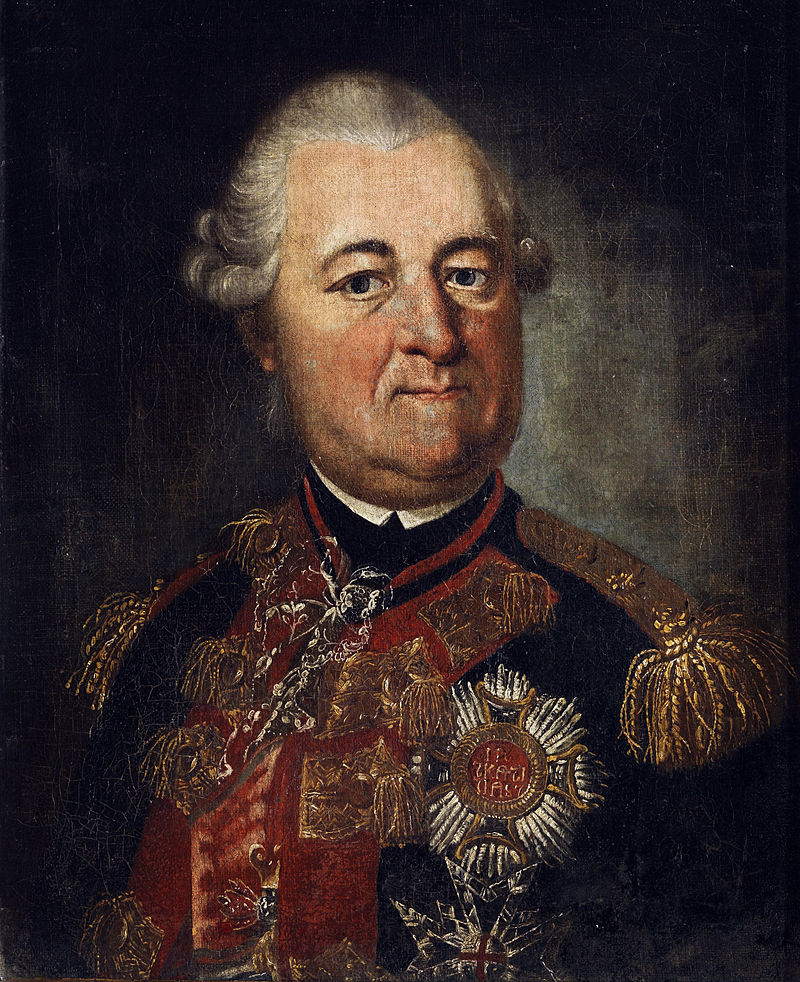
Charles Theodore II
Reign
German States Bavaria (1777 – 1799)
Description
Károly Tivadar (Drogenbos, December 11, 1724 - Nymphenburg Castle, February 16, 1799) Elector of Palatinate from 1742 to 1777 and Elector of Bavaria from 1777 to 1799, Prince of Bavaria, member of the House of Wittelsbach, ascended the throne in 1777 after the Wittelsbachs his Bavarian (younger) branch became extinct, and he inherited the Bavarian throne under a dynastic treaty of 1724. As Elector, Károly Tivadar took an active role in Bavarian politics and supported the arts and sciences. In 1778, the Bavarian War of Succession broke out, and this year Károly Tivadar moved from Mannheim to Munich. 1799. on February 12, Károly Tivadar suffered a stroke and died. With his death, the Pfalz-Sulzbach branch of the Wittelsbachs died out, so Churpfalz-Baiern passed to the Pfalz-Zweibrücken branch of the dynasty. Successor of Károly Tivadar IV. Miksa (József) became Duke of Palatinate-Zweibrücken, who later, in 1806, as an ally of Emperor Napoleon, became King of Bavaria under the name Miksa I. Károly Tivadar married twice. His first wife was Princess Elizabeth Augusta III. He is the eldest grandson of Elector Fülöp Károly of Palatinate, whom he married on January 17, 1742. They had one child (József Ferenc Lajos, June 28-29, 1761), who only lived for a few days. Erzsébet Augusta died on August 17, 1794. Károly Tivadar married for the second time on February 15, 1795, he married Archduchess Mária Leopoldina, who, however, did not give birth to an heir, outliving her elderly husband by almost half a century.
Minting information
II. Duke Károly Tivadar (1724-1799) was a member of the House of Wittelsbach, who became the Elector of the Palatinate from 1742 and the Elector of Bavaria from 1777. II. At the end of the 18th century, Károly Tivadar's coinage was considered the most advanced among the German states, as the duke paid a lot of attention to financial reforms, the regulation of coinage and the fight against counterfeiting. The duke's coinage took place in several locations. The mint masters engraved the prince's coat of arms, name, rank and reign on the coins, as well as the marks of the mint and the monograms of the mint masters. The prince's mint issued coins in various metals such as gold, silver, copper, billon (copper- silver alloy) and vellon (copper-tin alloy). The value of the coins depended on the metal content and weight and was determined according to the German imperial monetary system.II. Among the coins issued by Károly Tivadar's mint, the most well-known are the following. The ducat (ducatus) was a gold coin with a value of 24 kreuzers. The coin bears the prince's portrait and coat of arms, as well as the inscription: CAR. THEOD. DGCPRVBDSRIA & EL. LL (Károly Tivadar, by the grace of God Elector of the Palatinate and Bavaria, Archduke and Elector of the German-Roman Empire, Lord of Lotharingia and Leuchtenberg). The taler (thaler) is a coin made of silver, the value of which was 60 kreuzer. On the coin we can see the prince's coat of arms and the marks of the mint, as well as the inscription: CAR. THEOD. DGCPRVBDSRIA & EL. LL .The kreuzer (crucis) was a billon or vellon coin with a value of 1/60 taler. The coin bears the coat of arms of the prince and the marks of the mint, as well as the inscription: CAR. THEOD. DGCPRVBDSRIA & EL. LL The pfennig (denarius) was a copper coin worth 1/240 taler. On the coin we can see the prince's coat of arms and the marks of the mint, as well as the inscription: CAR. THEOD. DGCPRVBDSRIA & EL. LL