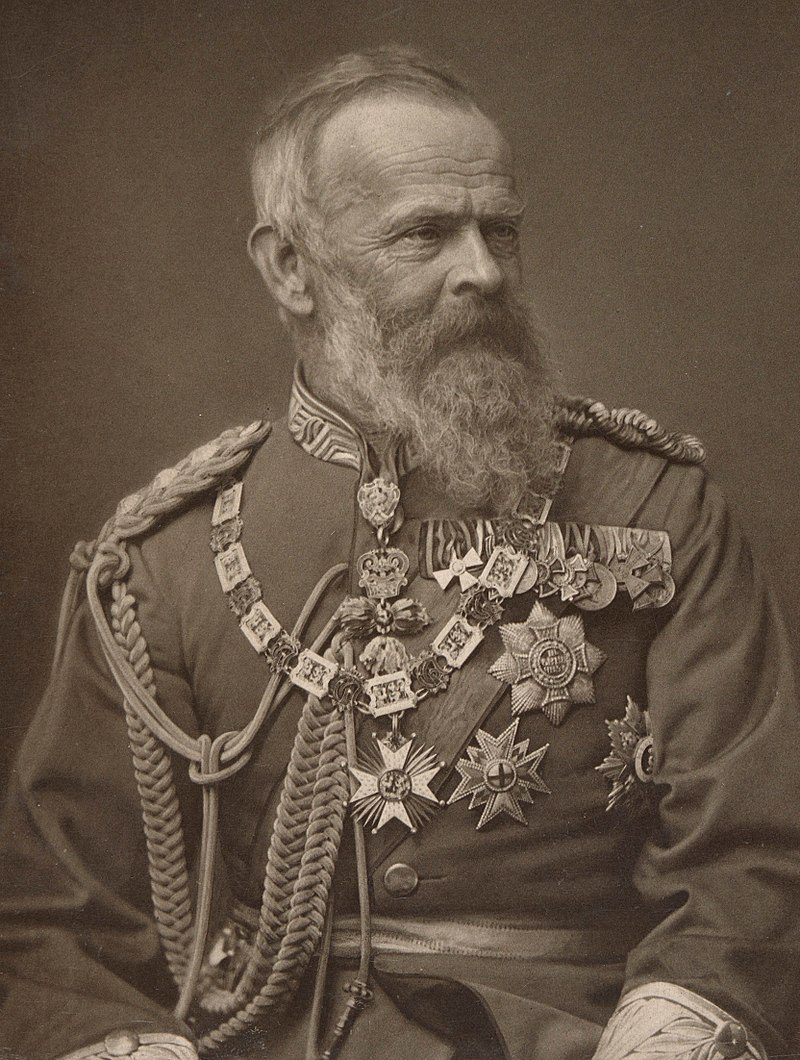
Luitpold
Reign
German States Bavaria (1821 – 1912)
Description
Prince Luitpold of Bavaria, who was born on March 12, 1821 in Würzburg and died on December 12, 1912 in Munich, was the de facto ruler of Bavaria from 1886 to 1912 as regent for his nephews II. For kings Louis and Otto. Luitpold's regency became necessary due to the mental incapacity of his nephews. Luitpold was born as the third son of the Bavarian royal family, the child of King Louis I and Queen Theresa of Saxe-Hildburghausen. He entered the military and in 1835 was promoted to captain of the artillery. During the revolutions of 1848, he acted as a mediator and allowed disaffected citizens to receive an audience from his father. His brother, II. During the reign of Maximilian (1848–64), Luitpold did not play a significant political role. His nephew, II. During the reign of Louis (1864–1886), Luitpold increasingly had to represent the royal house due to the king's long absence. In the Austro-Prussian War of 1866, Luitpold was the commander of the 3rd Royal Bavarian Brigade. After the war, he participated in the reorganization of the Bavarian army. In 1869, he was appointed inspector general of the Bavarian army, and during the Franco-Prussian war of 1870-71, he represented Bavaria at the German High Command. In this capacity, it was handed over by II. The Kaiserbrief to Louis on December 3, 1870, in which Louis supported the creation of the German Empire with the King of Prussia, Kaiser Wilhelm I, at its head. Since Louis, who nevertheless regretted the loss of Bavaria's independence, refused to participate in William's coronation as emperor on January 18 at the Palace of Versailles, Louis' brother, Prince Otto, and his uncle, Luitpold, represented him. Luitpold's liberal principles as regent soon won public opinion. support. Through electoral reforms (1906) and the introduction of ministerial responsibility, Bavaria became the most democratically governed kingdom in Germany. Despite the reservations of the German Emperor II. Regarding William's policy, Luitpold remained strictly loyal to the German government. 1844. On April 1, in Florence, Luitpold married Archduchess Ferdinand Augusta of Austria, Duchess of Tuscany, II. The second daughter of Grand Duke Lipót of Tuscany. Luitpold and Auguste had four children: III. King Louis of Bavaria (1845–1921, Prince Miksa József Lipót Mária Arnulf of Bavaria (1846–1930), Princess Therese Charlotte Marianne Auguste of Bavaria (1850–1925), Prince Franz Joseph Arnulf Adalbert Maria of Bavaria (1852–1907). 26 years of Luitpold's regency It was known as the Golden Age of Bavaria. Munich, the capital, was recognized as the cultural center of Europe. The regent was a friend of many artists, and he established the Künstlerhaus as a meeting place and exhibition center after his death, his eldest son ruled as regent and then king as Louis III.
Minting information
The coinage of Regent Luitpold German States Bavaria from 1821-1912 followed the traditional Bavarian coinage practice. The first coins minted in Luitpold's name were issued in 1821. These were silver coins with a face value of 1 and 2 krajcár. In the following years, more and more denominations and coins made of metal were minted. In 1832, silver coins with a nominal value of 10 and 20 krajcár and copper coins with a nominal value of 1 and 2 pfennig were introduced. In 1848, as a result of the revolution, the liberal monetary system was also introduced in Bavaria. According to this, the pfennig replaced the krajczar, and in the coinage they switched to the German coinage system. During the reign of Regent Luitpold, the following denominations of money were minted in Bavaria: 1, 2, 3, 5, 10, 20, 50, 100, 200, 500 and 1000 pfennigs, 1, 2, 3, 5, 10 and 20 krajcár, 1, 2, 5, 10, 20, 50 and 100 forints. During the reign of Luitpold, the coinage of Bavaria developed significantly. Modern machines began to be used in the mints, and the quality of the coins improved. The most frequently minted nominal value coin was the 10 pfennig. Among the coins bearing the regent's name, the 1,000 forint gold coins are the most valuable. During the reign of Regent Luitpold, the Bavarian mint played an important role in the development of the German monetary system.

