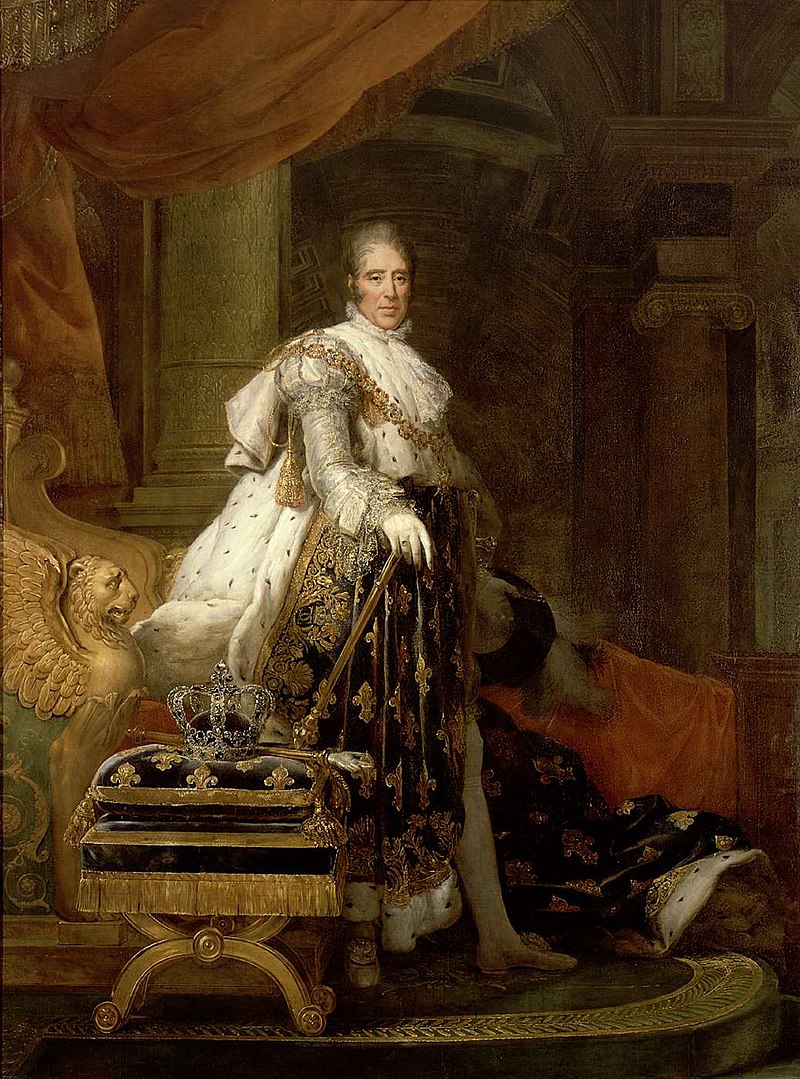
Charles X
Reign
France (1824 – 1830)
Description
The reign of King Charles X of France (Charles Philippe; October 9, 1757 – November 6, 1836) lasted from September 16, 1824 to August 2, 1830. He was XVI. Louis and XVIII. The younger brother of King Louis, as well as the uncrowned XVII. Grandson of Lajos. After the restoration of the House of Bourbon in 1814, Charles X (as heir to the throne) became the leader of the ultra-royalists, who supported absolute monarchy by divine right and opposed the concessions and civil liberties of the constitutional monarchy provided by the 1814 Charter.X. During Charles' reign, governments compensated landowners who lost their lands due to the abolition of the feudal system, thereby increasing the power of the church and re-introducing the death penalty for sacrilege, which caused conflict with the liberal majority House of Representatives. Charles X also approved the French conquest of Algeria as a way to distract his citizens from domestic political problems and forced Haiti to pay a large indemnity in exchange for lifting the blockade and recognizing Haitian independence. He eventually appointed a conservative government led by Prince Jules de Polignac , which was defeated in the French elections of 1830. He became increasingly unpopular with liberals during his reign and was eventually overthrown during the July Revolution of 1830. He was then exiled to England, Scotland, Prague and finally to Istria, where he died in 1836. In November 1773, Károly married Mária Theresa of Savoy. In 1775, Mária Theresa gave birth to a son, Louis Antoine, whom XVI. Louis made him duke of Angoulême. Louis-Antoine was the first of the next generation of Bourbons. Three years later, in 1778, Károly's second son, Ferdinand Károly, was born, who received the title of Duke of Berry.
Minting information
King Charles X of France reigned from 1824 to 1830. Its coinage followed the classical traditions, but also contained many innovations. The most significant innovation was the introduction of copper coins. Until now, copper coins were minted only in small quantities, but during the time of Charles X, their output increased significantly. The purpose of the copper coins was to improve the circulation of petty cash. Another innovation was the introduction of nominal silver coins. Until now, silver coins were evaluated based on weight, but in the time of Charles X, face value coinage was introduced. This made it easier to use money and determine its value. X. Károly's coinage was largely successful. The coins were of good quality and popular with the population.