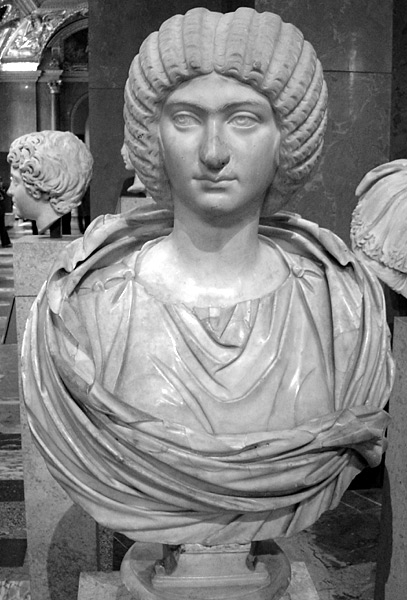
Julia Domna
Reign
Roman Empire (193 – 211)
Description
Wife of Septimius Severus and daughter of Julius Bassianus.
Minting information
Empress Julia Domna ruled from 193 to 211 alongside her husband Septimius Severus. During this period, he introduced many new types of money, which played a significant role in the history of Roman coinage. Domna mainly focused on the minting of gold and silver coins. These coins were of a higher quality than earlier ones and were often artistically decorated. Domna's coins were very popular in the Roman Empire and played an important role in strengthening the imperial power. One of the most important types of Domna's coins was the aureus, which was a gold coin. The aureus featured a portrait of Domna, often with the emperor. Aureus were among the most valuable coins of the Roman Empire and were often used in trade and international payments. Another important type of money in Domna was the denarius, which was a silver coin. On the denarii, Domna's portrait was shown either together with the emperor or alone. Denarius were among the most common coins of the Roman Empire and were widely used in everyday life. The minting of Domna was an important milestone in the history of Roman coinage. High-quality and artistically decorated coins contributed to the economic and cultural development of the Roman Empire. Some concrete examples of Domna's coins: Gold aureus: The aureus shows a portrait of Domna, often with the emperor. The inscription is as follows: "IVLIA PIA FELIX AVGVSTVS". Silver denarius: On the denarius, the portrait of Domna was shown either together with the emperor or alone. The inscription is as follows: "IVLIA DOMNA AVGVSTA".Bronze as: The portrait of Domna was shown either together with the emperor or alone. The inscription is as follows: "IVLIA DOMNA AVGVSTA". Coins of Domna are still very popular among numismatic collectors.

