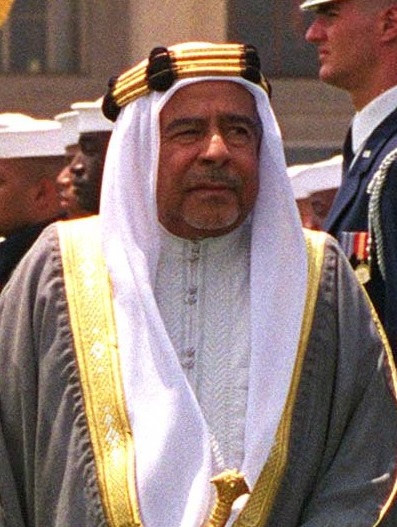
Isa bin Salman
Description
Isa bin Salman bin Hamad Al Khalifa (Arabic: عيسا بن سلمان آل خليفة) was a Bahraini royal who served as the first Emir of Bahrain from 1961 until his death in 1999 (he also previously ruled as Hakim of Bahrain until 16 August 1971). Isa was born in Jasra and became Emir after the death of his father Salman bin Hamad Al Khalifa in November 1961. In 1971, during Isa's reign, Bahrain gained independence from the United Kingdom. Subsequently, the country also considered joining the United Arab Emirates, but Isa withdrew this intention (along with Qatar) due to dissatisfaction with the proposed constitution. In 1973, Isa tried to introduce a moderate form of parliamentary democracy, and men (but not gave women) the opportunity to vote in the parliamentary elections. In 1975, he dissolved the parliament because it did not approve the 1974 State Defense Act supported by the government. The parliamentary system was not reinstated during his lifetime, as Emir Isa occasionally had to face left-wing and Islamist demonstrations. 1971-1999: An agreement was reached between Isa and his brother, Khalifa bin Salman. Isa assumed the role of diplomat and master of ceremonies, while Khalifa managed the government and the economy as prime minister. Isa bin Salman Al Khalifa was also one of the founders of the Dar Al Maal Al Islami Trust, which was launched in 1981 by Saudi King Mohammed bin Faisal Al Saud. Isa 1999 He died in , and is buried in Al Rifa'a Cemetery in Manama.
Minting information
The reign of Isa Bin Salman Bahrain (1961-1999) marked an important period in the history of Bahrain, during which the dinar was introduced and modern coinage was created. Before 1961: Bahraini rupee (1 rupee = 100 fils), after 1965: Bahraini dinar (1 dinar = 1000 fils) was the official currency. The coins were minted in denominations of 1, 5, 10, 25, 50 fils and 1 dinar, the material was aluminum, bronze, nickel and copper. Bahraini coat of arms or other national symbols were featured. Banknotes were printed in denominations of 5, 10, 25, 50, and 100 dinars, made of paper, and decorated with motifs from Bahraini culture and history. Numerous commemorative coins were also minted during the reign of Isa bin Salman to commemorate prominent events and anniversaries. .Major events: 1965: Introduction of the dinar, at an exchange rate of 1 dinar = 10 rupees. 1973: As a result of the oil price explosion, the Bahraini economy boomed, the value of the dinar increased. 1980s: Modernization of the mint, introduction of new coins and banknotes. Isa bin Salman his portrait appeared on Bahraini coins and banknotes between 1965 and 1999. The Bahraini dinar is still one of the most stable currencies in the region.

Bahrain Isa bin Salman Al Khalifa (1961-1999) 5 Fils Coin
Available: 1 pcs (1 seller)
600 Ft
Bahrain Isa bin Salman Al Khalifa (1961-1999) 10 Fils Coin
Available: 2 pcs (1 seller)
700 Ft – 900 Ft
Bahrain Isa bin Salman Al Khalifa (1961-1999) 25 Fils Coin
Available: 1 pcs (1 seller)
600 Ft
Bahrain Isa bin Salman Al Khalifa (1961-1999) 100 Fils Coin
Available: 1 pcs (1 seller)
800 Ft
Bahrain Isa bin Salman Al Khalifa (1961-1999) 50 Fils Coin
Available: 1 pcs (1 seller)
800 Ft

Bahrain Isa bin Salman Al Khalifa (1961-1999) 10 Fils Coin

Bahrain Isa bin Salman Al Khalifa (1961-1999) 5 Fils Coin
Bahrain Isa bin Salman Al Khalifa (1961-1999) 25 Fils Coin
Bahrain Isa bin Salman Al Khalifa (1961-1999) 100 Fils Coin