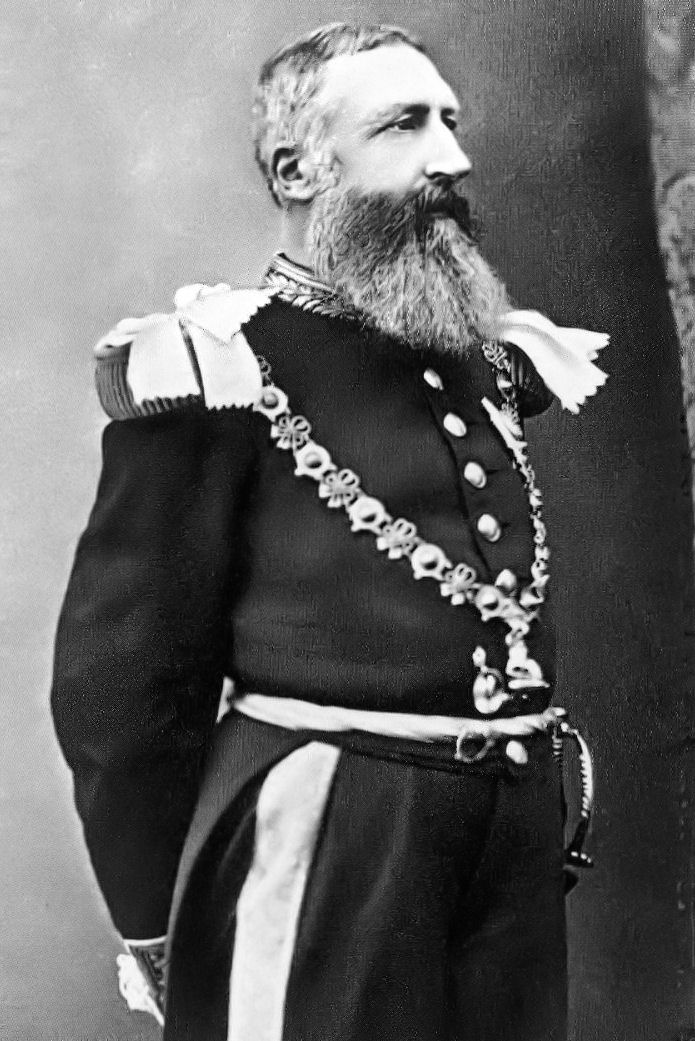
Leopold II
Reign
Belgium (1865 – 1909)
Congo (Zaire) (1885 – 1908)
Description
II. Leopold, King of the Belgians, was born on April 9, 1835 in Brussels and died on December 17, 1909 at age 74 in Laeken, Brussels. He was the second son of King Leopold I of Belgium. After inheriting the throne after his brother's death, he ascended to the royal position in 1865 and ruled until his death in 1909. II. Lipót was the brother of Empress Sarolta of Mexico and his first cousin was Queen Victoria of Britain. Outside of Belgium, he gained fame for the acquisition and ruthless exploitation of the African colony known as the Congo Free State. The colony included the entire territory of the modern Democratic Republic of the Congo, more than 2 million km². Forced labor was used to extract the colony's main products, rubber and ivory, and non-compliance with the extraction quotas imposed on the locals led to mutilations and murders. The Congo Free State ceased to exist in 1908, but by then it is estimated that the colony had lost 50% of its former population, and around 15 million people had died due to Leopold's policies. The king did not confess to his actions. By 1908, the profitability of rubber extraction had decreased compared to the beginning of colonization, so Lipót gave up his private colony without much opposition. Two decades of exploitation brought him hundreds of millions, of which he lived carefree and spent a lot on luxury. He never saw with his own eyes what his people in the Congo committed in his name, and he never showed remorse for what happened in the country. II. Lipót's wife was Austrian Archduchess Mária Henrietta (1836–1902), daughter of Palatine József and Princess Mária Dorottya of Württemberg. From the marriage, which was concluded on August 22, 1853, four children were born: Lujza Mária Amália, born on February 18, 1858 in Brussels and died on March 1, 1924 in Wiesbaden. Her husband was Ferdinand Philip, Duke of Saxe-Coburg-Gotha. Léopold Ferdinand Elie Victor Albert Marie, Leopold's eldest son and heir, held the title of Count of Hainaut and later Duke of Brabant. She was born in Laeken on June 12, 1859 and died there as a result of pneumonia on January 22, 1869, after falling into one of the pools in the courtyard of the castle. Stéphanie Clotilde Louise Herminie Marie Charlotte, born on May 21, 1864 in Brussels and died on August 23, 1945. died in Pannonhalm Abbey. Her first husband was the Austrian Archduke Rudolf (1858–1889), her second husband was the Hungarian count Elemér Lónyay of Nagylonya and Vásárosnamény (1863–1946).Clémentine Albertine Marie Léopoldine, born on July 30, 1872 in Brussels and died on March 8, 1955 in Nice. Her husband is Prince Napoléon Victor Jérôme Frédéric Bonaparte (1862–1926), head of the Bonaparte family.
Minting information
II. King Leopold of Belgium ascended the throne in 1865 and ruled until his death in 1909. During this time, significant changes took place in the Belgian coinage, which were also influenced by the personal interests of the king. In the first decades of the reign of Leopold, traditional gold and silver coins were typical of the Belgian coinage. However, in 1875, the king established his African colony called the Congo Free State, which was a significant source of income for him. In order to finance the treasures from the Congo, Lipó ordered Congolese francs to be minted at the Belgian mint. These coins were made of gold and silver and depicted the coat of arms of the Congo Free State and the king's monogram. In 1885, the independence of the Congo Free State was recognized at the Berlin Conference and became the personal property of Lipót. From then on, the king placed even greater emphasis on the exploitation of the resources from the Congo Free State. As a result, the Congolese francs played an increasingly important role in the Belgian coinage. In 1896, Lipót ordered that instead of Congolese francs, only the money of the Congo Free State, Congolese gold and Congolese silver should be minted at the Belgian mint. These coins differed significantly from the traditional Belgian coins and depicted the coat of arms of the Congo Free State and the king's monogram.II. After the death of Lipót, the Congo Free State became a Belgian colony, and traditional gold and silver coins once again came to the fore in Belgian coinage.
Belgium Leopold II (1865-1909) 1 Centimes Coin (french text)
Available: 1 pcs (1 seller)
1 800 Ft
Belgium Leopold II (1865-1909) 5 Centimes Coin (dutch text)
Available: 4 pcs (1 seller)
900 Ft – 2 500 Ft
Belgium Leopold II (1865-1909) 5 Centimes Coin (french text)
Available: 1 pcs (1 seller)
800 Ft
Belgium Leopold II (1865-1909) 2 Centimes Coin (DutchText)
Available: 1 pcs (1 seller)
500 Ft
Belgium Leopold II (1865-1909) 10 Centimes Coin (French text)
Available: 5 pcs (1 seller)
700 Ft – 1 900 Ft
Belgium Leopold II (1865-1909) 10 Centimes Coin (Dutch text)
Available: 4 pcs (1 seller)
500 Ft – 1 800 Ft
Belgium Leopold II (1865-1909) 10 Centimes Coin Dutch Text
Available: 1 pcs (1 seller)
1 900 Ft
Belgium Leopold II (1865-1909) 2 Centimes Coin (French Text)
Available: 1 pcs (1 seller)
700 Ft
Belgium Leopold II (1865-1909) 1 Franc French text .835 Silver Coin
Available: 1 pcs (1 seller)
5 400 Ft
Belgium Leopold II (1865-1909) 25 Centimes

Belgium Leopold II (1865-1909) 25 Centimes

Belgium Independence 1 Francs .835 Silver