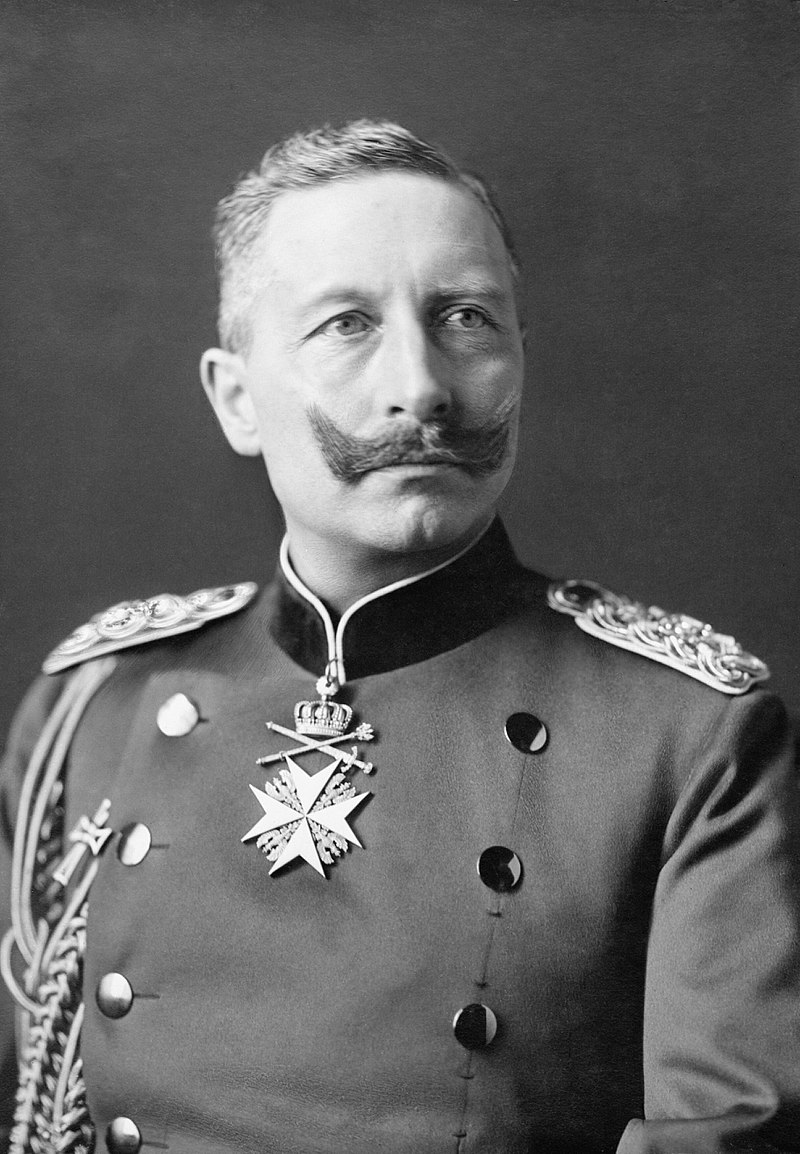
Wilhelm II
Description
Wilhelm II was born in 1859 in Potsdam, as the oldest child of Emperor Frederick III and Empress Victoria of Germany.
The interesting thing about his life was that there were difficulties during childbirth. An English doctor pulled the little Wilhelm out of his mother's womb by his arm. As a result, he became paralyzed in that arm.
He began his studies with a private teacher, later in Kassel, and then at Germany's largest university, the University of Bonn, which in 1818 the Prussian king Friedrick William III founded and continued his studies. After that, he joined the army, moving away from his parents. He did not have a good relationship with his mother, as she wanted him to receive a 19th-century liberal British upbringing. Wilhelm therefore decided to rule with a firm hand.
In 1881, he married Victoria Augustus, Princess of Schleswig-Holstein, with whom they had 7 children.
After his grandfather, the German Emperor William I died in 1888, Frederick William III ascended the throne. His aim was to change the government and transfer the Reichstag to the chancellor, but this did not happen due to his early and sudden death. This is how the 29-year-old Wilhelm became the emperor of the German Empire.
In 1918, the emperor resigned, which caused many people to demand his death. He sought refuge in the Netherlands, but repeatedly expressed his desire to return home, but it was always rejected. His wife died in 1922, and later he married Princess Hermine von Schönaich-Carolath, also a widow.
In 1933, when Adolf Hitler came to power, he wanted to regain his lost throne, but he was no longer able to do so. He died in 1941.
Minting information
II. Wilhelm, King of Prussia, German Emperor, reigned from 1888 to 1918. During this period, there were no significant changes in the German coinage, the previous practice was followed. The most common minting materials were gold, silver and bronze. Among the gold coins, the 20 mark was the most valuable, and the silver 10 and 5 marks were the most common. Among the bronze coins, 1 and 2 marks were the most common. II. William's portrait can be seen on the obverse of most coins, and the coat of arms of the German Empire is on the reverse. The monarch's royal name "W" also often appears on the surface of the coins. During the war years, the amount of coinage was greatly increased to meet the needs of the war. Many new coins were minted at this time, including the 10 and 20 pfennig bronze coins and the 1 and 2 pfennig silver coins.

Prussia Wroclaw University 3 Mark .900 Silver Coin
Available: 1 pcs (1 seller)
39 000 Ft

Prussia Reign of King Wilhelm II 2 Mark .900 Silver Coin
Available: 1 pcs (1 seller)
22 500 Ft
Germany Wilhelm II (1888-1918) 25 Pfennig Coin
Available: 1 pcs (1 seller)
6 500 Ft
Prussia Wilhelm II (1888-1918) 3 Mark .900 Silver Coin
Available: 1 pcs (1 seller)
28 500 Ft

Germany Second Empire Wilhelm II (1888-1918) 10 Pfennig Coin
Available: 8 pcs (1 seller)
300 Ft – 3 700 Ft

Germany Second Empire Wilhelm II (1888-1918) 5 Pfennig Coin
Available: 1 pcs (1 seller)
500 Ft

Germany Second Empire Wilhelm II (1888-1918) 1 Pfennig Coin
Available: 14 pcs (1 seller)
500 Ft – 2 500 Ft

Germany Second Empire Wilhelm II (1888-1918) 1/2 Mark .900 Silver Coin
Available: 19 pcs (1 seller)
3 200 Ft – 5 900 Ft

Germany Second Empire Wilhelm II (1888-1918) 2 Pfennig Coin
Available: 3 pcs (1 seller)
1 900 Ft – 3 900 Ft

Germany Wilhelm II (1888-1918) .900 Silver 1 Mark
Available: 3 pcs (1 seller)
6 500 Ft

Prussia Wilhelm II (1888-1918) 1 Kopeck

Germany Wilhelm II Military Coinage 3 Kopecks Coin