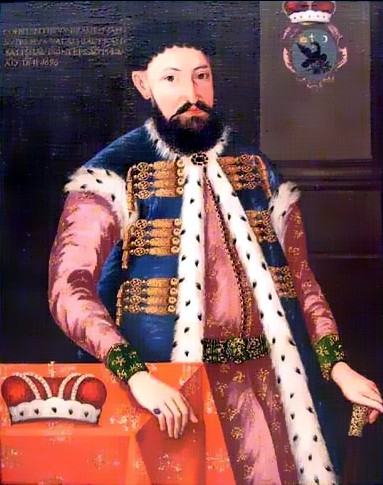
Constantin II
Reign
Romania (1688 – 1714)
Description
II. (Saint) Constantine (Romanian: Constantin Brâncoveanu) was the prince of Havasalföld between 1688 and 1714. II. Constantine came from a family of Craiovești boyars and was related to Matei Basarab. He was brought up in the house of his uncle Constantin Cantacuzino. After Șerban Cantacuzino died under suspicious circumstances, Brâncoveanu came to the throne. At first he was supported by Constantin Cantacuzino, but later they clashed and Cantacuzino was forced into exile. His wife, Maria, was the daughter of Antal Vodă. They had four sons (Constantin, Ștefan, Radu and Matei) and seven daughters (Stanca, Maria, Safta, Ancuța, Elenca, Bălașa and Smaranda). II. Constantine successfully balanced between the Ottoman Empire and the German-Roman Empire. In 1709, however, political mistakes and the unfavorable situation in Europe led to the downfall of the family. His alliance with the Tsar and his plans against the Turkish Sultan failed. He returned the gold he received to the tsar and gave the supplies to the Turks. II. Konstantin Brâncoveanu finally died in Istanbul on August 15, 1714. He was the supporter of culture and the last great prince of the Principality of Havasalföldi.
Minting information
II. Prince (Saint) Constantine (1688-1714) ruled Havasalföld under Turkish rule, but made secret alliances with the German-Roman Emperor and the Russian Tsar, to whom he provided financial support. The prince was rich and educated, he spent a lot on the arts, the architecture and book printing. II. Constantine operated his own mint, minting gold, silver and copper coins. The coins usually depicted the prince's portrait, coat of arms, name and reign, and bore Latin, Greek, Cyrillic and Arabic inscriptions. Coinage was a symbol of the prince's power and wealth, but it was also a means of paying Turkish taxes, and the income from minting was partially he transferred it to the Turkish Porte, and partly used it for his own purposes. The prince's coinage ended in 1714, when the Turkish Sultan captured and executed him and his four sons because he discovered his secret alliances. The property of the prince was confiscated, the mint was closed, and the money was destroyed or punched.
