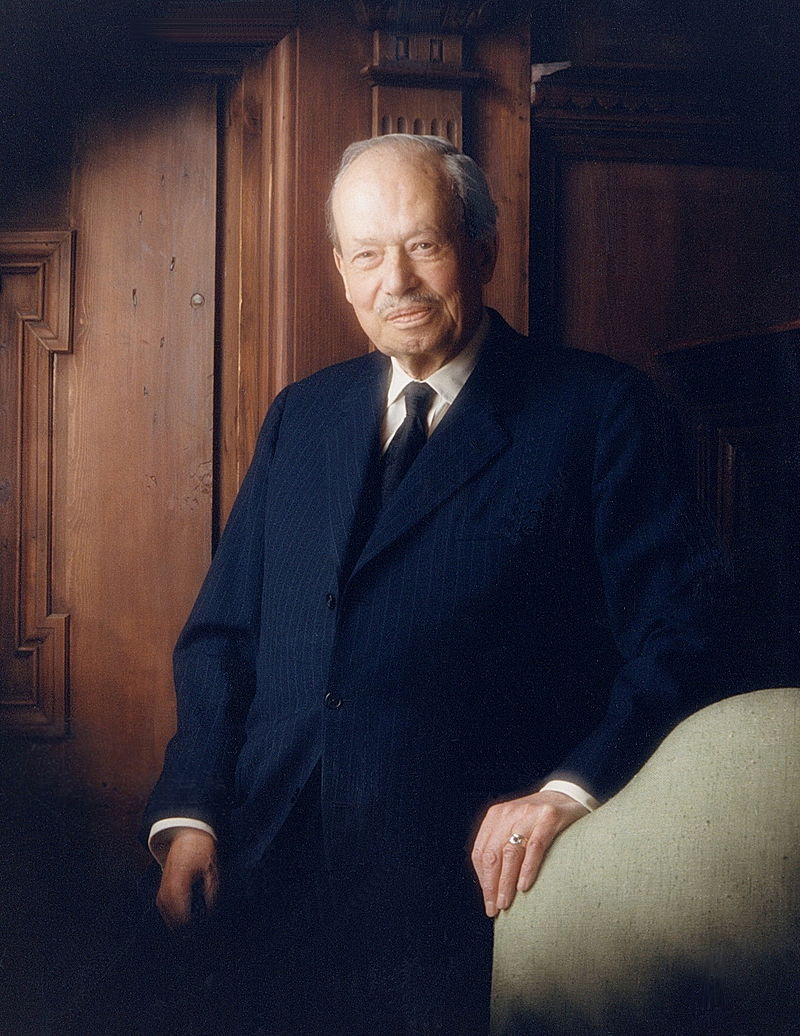
Franz Joseph II
Reign
Liechtenstein (1938 – 1989)
Description
II. Ferenc József, full name Franz Josef Maria Aloys Alfred Karl Johannes Heinrich Michael Georg Ignatius Benediktus Gerhardus Majella von und zu Liechtenstein, was born on August 16, 1906 in the Frauenthal castle in the city of Deutschlandsberg. He was the first son of Aloys von und zu Liechtenstein and Archduchess Erzsébet Amália of Habsburg. His godfather was Emperor Franz Joseph himself. He spent his childhood in the family's various castles in Austria and Moravia. He later graduated from the Schottengymnasium in Vienna and then studied forestry at the Vienna College of Agriculture. He also managed the family's properties in Silesia. 1938. on March 30, due to his poor health, Ferenc I gave him the power of regency. A few months later, on July 25, the reigning prince died, and II. Francis Joseph inherited the Duchy of Liechtenstein and the possessions in Austria, Moravia and Silesia. He was the first reigning prince to move the ducal seat from Moravia to Liechtenstein. His spouse was Countess Georgina von Wilczek. His children included II. Prince János Ádám of Liechtenstein, Prince Nikolaus of Liechtenstein, Princess Nora, Marchioness of Mariño, Prince Philipp of Liechtenstein and Prince Wenzel of Liechtenstein. II. Prince Ferenc József Liechtenstein died on November 13, 1989, at the age of 83, and is buried in Vaduzi Cathedral. During his long life, he did a lot for Liechtenstein and his commitment to his family was exemplary.
Minting information
II. Prince Franz Josef was the ruler of Liechtenstein from 1938 to 1989. During his reign, the Liechtenstein coinage underwent significant changes. In 1938, after the annexation of the German Empire, the Liechtenstein coinage practically ceased. The German imperial mark became the official currency of the duchy. In 1945, after the Second World War, Liechtenstein regained its independence. At that time, the principality started minting its own money again. In the 1950s, the coins of Liechtenstein were primarily intended for foreign collectors. The coins depicted a variety of subjects, including historical figures, heraldic elements and natural landscapes. From the 1960s, Liechtenstein's coinage began to become more widely popular. The duchy then began to distribute its coins all over the world. II. During the reign of Prince Franz Josef, Liechtenstein's coinage developed significantly. The duchy's coins are now one of the most sought-after numismatic objects in the world. Some specific examples II. On the coins minted by Prince Franz Joseph: the 2-franc silver coins minted in 1946 depict the duchy's ruling family. The 5-franc silver coins minted in 1954 depict the natural beauties of the duchy. The 10-franc silver coins minted in 1964 depict the history of the duchy. II. The coinage of Prince Franz Joseph contributed to increasing Liechtenstein's international reputation.