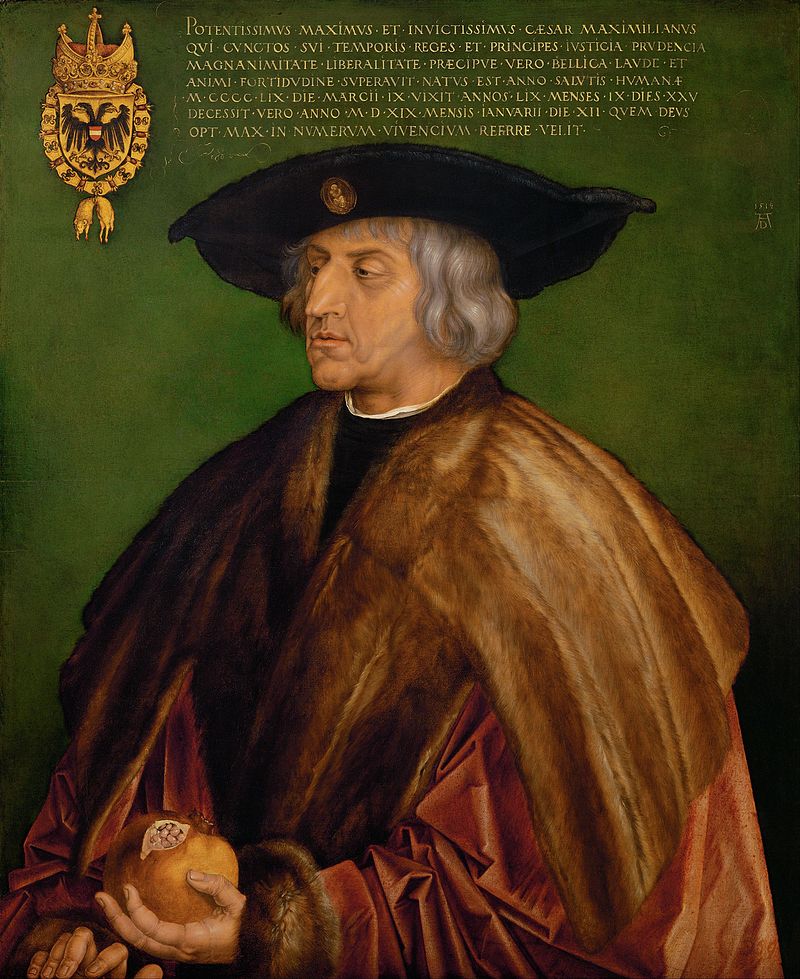
Maximilian I
Description
Maximilian was born in Bécsújhely in 1459, as the child of the German-Roman Emperor Frederick III and the Infanta Eleonora of Portugal.
Maximilian married Mary of Burgundy in 1477, thus acquiring the Low Countries under the jurisdiction of Burgundy and the County of Burgundy. His wife died in 1482, so he administered his Dutch heritage on behalf of his minor son.
In 1486, his father elected him king of Germany. His goal was to grab as many estates as possible, so he primarily bought Tyrol and Upper Austria from his cousin, Archduke Sigismund of Austria, after the death of Matthias, he recaptured Vienna in 1490, and the following year he concluded the Bratislava Peace with Wladislaw II. In the peace, it was agreed that Wladlisaw received the Hungarian royal throne, but if he died without an heir, Miksa and his descendants would take over the power. He received the title of German-Roman Emperor in 1508.
He died in 1519. He was succeeded by his grandson Charles V, since his only legitimate son had already died.
Minting information
Miksa I ruled the German-Roman Empire from 1493 to 1519, and also held many other countries, including Austria, Hungary, and the Czech Republic. His minting activities served to develop the financial system of these countries and had a significant impact on medieval coinage. Miksa tried to unify the financial system of the German-Roman Empire and therefore introduced a uniform coinage. This meant that the same coins with the same weights and values were in circulation in all parts of the empire. He introduced many new types of coins, including gold forints, silver forints and copper coins. These new types contributed to the ease of money circulation and the development of trade. His coins were of high quality and often decorated with ornate designs. This contributed to increasing the financial strength of the empire. Miksa's minting activity had a significant impact on medieval coinage. He unified the financial system, contributed to the development of trade by introducing new types of coins, and minted high-quality coins that increased the financial power of the empire.
No coins linked to this ruler yet.