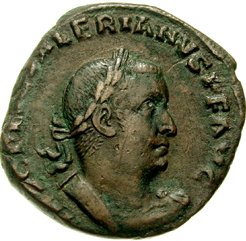
Valerianus I
Reign
Roman Empire (253 – 260)
Description
Descendant of the Valerian dynasty.
He ruled as a military emperor for 6 years, then died in Persian captivity.
Minting information
The coinage of Emperor Valerian I reflects the period between 253-260 of the Roman Empire. During this period, the empire was at war with the Persian Empire, which led to serious financial and economic problems. Due to the Persian War, the empire needed funds, so the weight and quality of the money was reduced. Following the tradition of military emperors, Valerian often depicted military motifs on the money. .Valerian issued two edicts against Christians, but Christian religious motifs appeared on the coins, such as the Christian symbol, the Chi Rho. Valerian's coinage was one of the signs of the empire's crisis. The decrease in the weight and quality of money reflected the economic decline, and the rise of military motifs reflected the military aspirations of the empire. The appearance of Christian religious motifs points to a growing Christianity in the empire. Among the specific types of money, the following were the most typical: Antoninianus: this was the type of money minted most often. Due to the Persian War, the weight of the money decreased from 2.5 grams to 2.2 grams, and its quality deteriorated. Denar: this was the second most frequently minted type of money. The weight of the money decreased from 3.3 grams to 2.8 grams, and its quality also deteriorated. Sestertius: this type of money was less common. The weight of the money decreased from 28.3 grams to 22.2 grams, and its quality also deteriorated. Valerian's coinage is an important source for learning about the period of the Roman Empire between 253-260.
