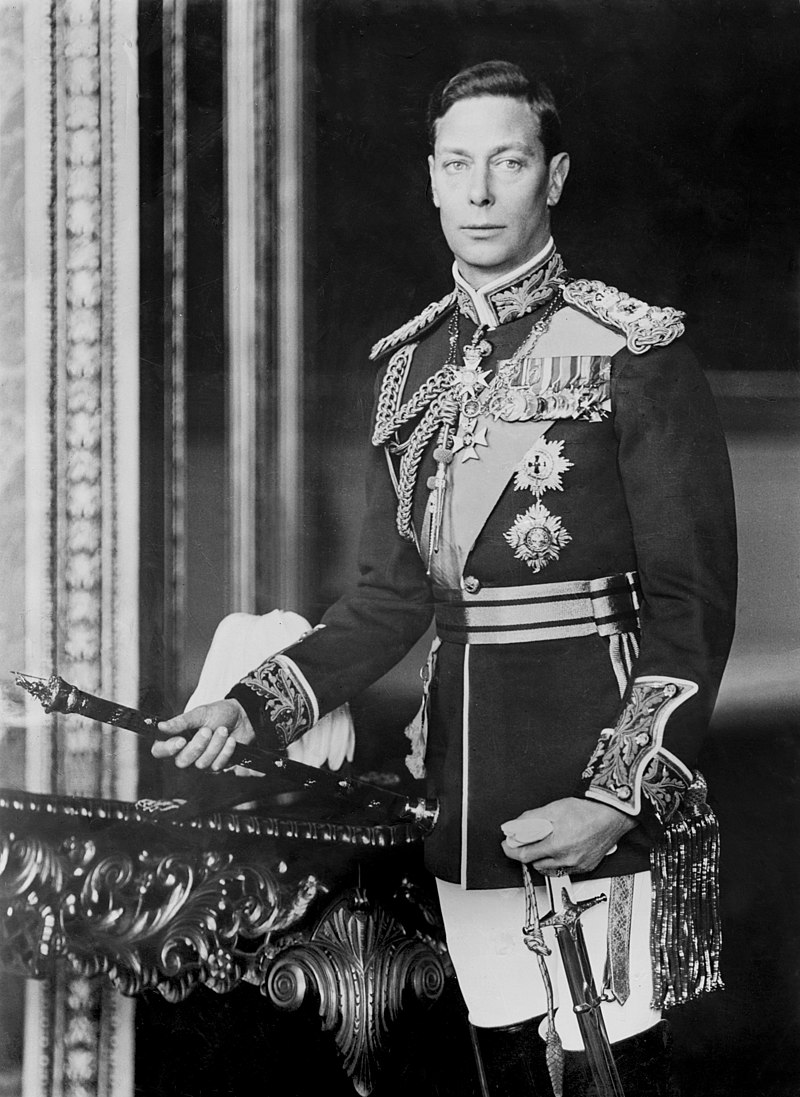
George VI
Reign
Australia (1936 – 1952)
British West Africa (1936 – 1952)
Brtitsh East Africa (1936 – 1952)
Canada (1936 – 1952)
Cyprus (1936 – 1952)
Fiji (1936 – 1952)
Hong Kong (1936 – 1952)
India (1936 – 1947)
Ireland (1936 – 1952)
Jersey (1936 – 1952)
Malaysia (1936 – 1952)
New Zealand (1936 – 1952)
Papua New Guinea (1936 – 1952)
South Africa (1936 – 1952)
Sri Lanka (1936 – 1952)
United Kingdom (1936 – 1952)
Zimbabwe (1936 – 1952)
Description
VI. George, originally Albert Frederick Arthur George of Windsor, was born on 14 December 1895 at Sandringham House, Norfolk, England. He was King of the United Kingdom and the Dominions of the British Commonwealth from 1936 until his death. VI. George was the last emperor of India and the first head of the Commonwealth of Nations. He served as an air force officer in the First World War as a child. In 1923, he married Elizabeth Bowes-Lyon, with whom he had two daughters, Elizabeth and Margit. In the 20s, he went to speech therapy for a long time due to his stuttering, which greatly improved his condition, but he never completely got over it. After the death of his father, György V. in 1936, his brother, VIII. Edward became the king of Great Britain, but he wanted to marry a twice-divorced American woman, Wallis Simpson. The Anglican Church did not allow this, so Eduard instead abdicated the throne so that he could marry his love. He was succeeded by Albert from December 11, 1936, who became the VI. He assumed the royal name George VI. During George's reign, the Second World War broke out, which brought serious trials to the country. The king remained in London even during the bombings, and with his brave example, he managed to restore the authority of the monarchy, which had been battered by the scandals of his brother. Although Great Britain was among the winners after the war, the British Empire fell apart at an ever-accelerating pace and was transformed into the British Commonwealth, India and Pakistan became independent in 1947, and Ireland, which became a republic, also left the Commonwealth in 1949.
Minting information
VI. The coinage of George, who reigned from 1936 to 1952, went through many changes before and during the Second World War. In the pre-war period, Verets had a traditional, distinctively British style. Portrait of the king below the crown, with text and coats of arms around him. During the war, the verets became much simpler to reduce the use of metal. The portrait of the king became smaller and the coats of arms were often missing. After the war, the verets returned to a more traditional style, but included some innovations. The portrait of the king became larger and coats of arms often became colorful. Some of the most valuable British coins were minted in the post-war period, including the 1951 Coronation Crown, one of the most valuable coins in the United Kingdom.

Zimbabwe George VI (1936-1952) 1/2 Crown
Available: 1 pcs (1 seller)
5 900 Ft

Australia George VI (1936-1952) .500 Silver 1 Florin
Available: 1 pcs (1 seller)
14 500 Ft

India George VI (1936-1947) 1 Anna
Available: 2 pcs (1 seller)
2 900 Ft – 6 900 Ft

Papua New Guinea George VI (1936-1952) 3 Penny
Available: 1 pcs (1 seller)
5 900 Ft

New Zealand Royal Visit .500 Silver 1 Crown
Available: 1 pcs (1 seller)
18 400 Ft

Sri Lanka George VI 1 Cents Coin
Available: 2 pcs (1 seller)
1 900 Ft – 2 500 Ft

South Africa George VI 2 1/2 Shilling .800 Silver Coin
Available: 1 pcs (1 seller)
14 700 Ft

British West Africa George VI (1936-1952) 3 Penny Coin
Available: 1 pcs (1 seller)
3 900 Ft

British West Africa George VI (1936-1952) 6 Penny Coin
Available: 1 pcs (1 seller)
16 500 Ft

South Africa George VI 2 1/2 Shilling .500 Silver Coin
Available: 1 pcs (1 seller)
9 200 Ft

Zimbabwe George VI (1936-1952) 6 Pence Coin
Available: 1 pcs (1 seller)
2 900 Ft

South Africa George VI 1 Shilling .800 Silver Coin
Available: 1 pcs (1 seller)
10 500 Ft