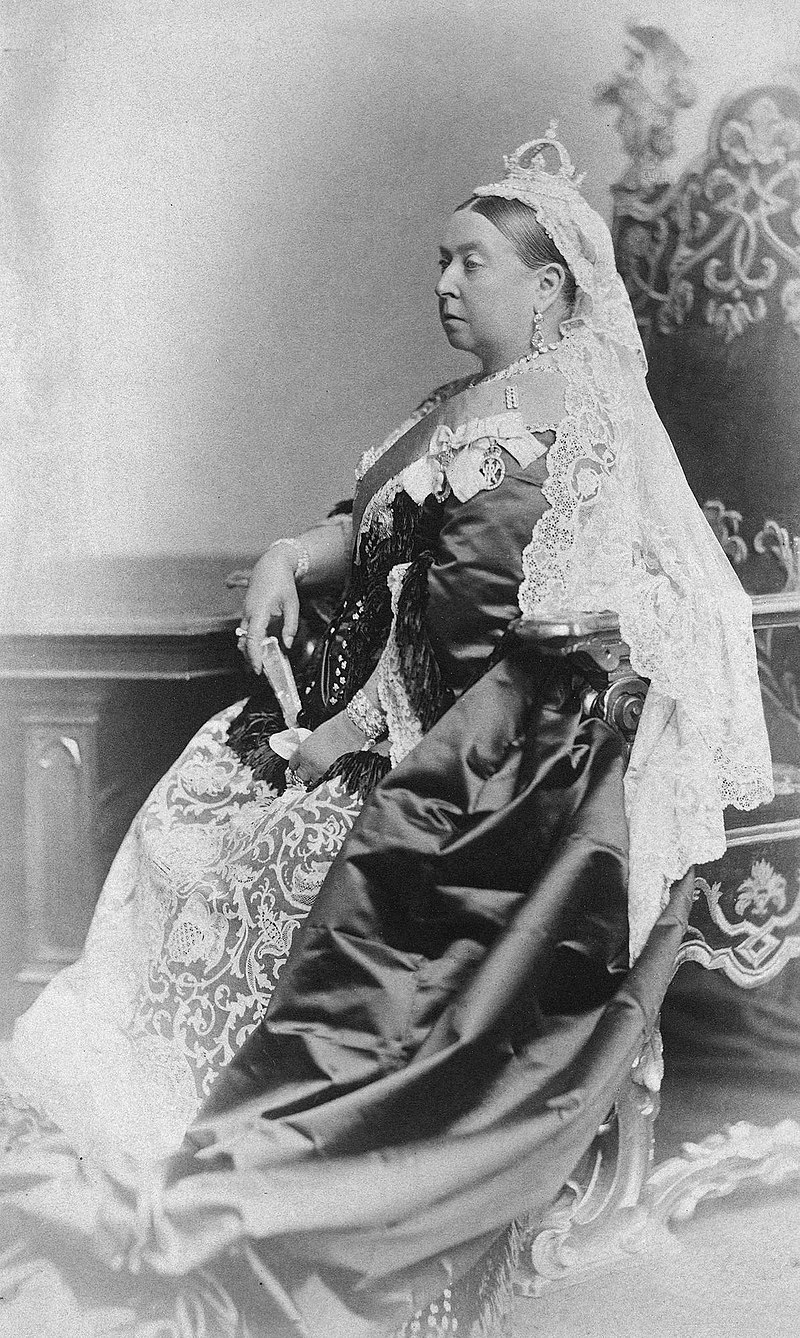
Victoria
Reign
Canada (1837 – 1901)
Cyprus (1837 – 1901)
Hong Kong (1837 – 1901)
India (1837 – 1901)
Ionian Islands (1837 – 1901)
Ireland (1837 – 1901)
Jersey (1837 – 1901)
Malaysia (1837 – 1901)
Mauritius (1837 – 1901)
Netherlands East Indies (1837 – 1901)
Straits Settlements (1837 – 1901)
United Kingdom (1837 – 1901)
Sri Lanka (1870 – 1901)
Description
Queen Victoria (English: Queen Victoria of the United Kingdom, full name Alexandrina Victoria; London, May 24, 1819 - London, January 22, 1901) Queen of the United Kingdom of Great Britain and Ireland June 20, 1837- from, Empress of India from May 1, 1876 until her death. Victoria to Prince Edward of Kent and Strathearn, III. She was the only child of the fourth son of the British King George. Both the king and the Duke of Kent died in 1820, so Victoria was brought up under the strict supervision of her German-born mother, Princess Victoria of Saxe-Coburg-Saalfeld. He ascended the throne at the age of 18, after his uncle IV. Vilmos died without an heir. At that time, the United Kingdom was already a constitutional monarchy, in which the ruler had only symbolic power. However, Victoria had great influence, as she was able to exert pressure on the government's policy and had a say in the appointment of ministers. She became a national symbol during her lifetime and was seen as the embodiment of strict moral principles. In 1840, she married her cousin, Prince Albert of Saxe-Coburg and Gotha. Of their nine children and 34 grandchildren, 26 married into the ruling and noble families of various countries on the continent. This earned Queen Victoria the nickname "Grandmother of Europe". After the death of Prince Albert in 1861, Victoria fell into a deep depression and avoided the public eye. She did not appear in public for months, and wore mourning clothes from then until the end of her life. She preserved her husband's memory until his death and did a lot to ensure that Albert was preserved in English memory in a dignified way. As a result of his imprisonment, republicanism temporarily strengthened, but it became popular again in the second half of his reign. Due to his reign of 63 years and 7 months, his great-grandson II. He was the second-longest-reigning British-English crown prince behind Elizabeth, and ranks among the longest-reigning monarchs of all time. The English 19th century was named after him, the Victorian era, which English historians consider to be the heyday of the United Kingdom. It was an age of industrial, cultural, political, scientific and military change in the United Kingdom, marked by the further expansion of the British Empire. In the process, the area of the empire tripled and reached 25,900,000 km², with a total of 410 million people under its authority. During the industrial revolution, his country became the world's leading industrial power. He was the last ruler of the House of Hanover. His son and successor, VII. Eduárd was the founder of the Szász-Coburg-Gothai House. He died of a stroke on January 22, 1901, at the age of 81. His son, the future VII. British King Edward and his eldest grandson, II. Emperor William of Germany stood by his bed. When he was placed in the tomb, it began to snow.
Minting information
During the reign of Queen Victoria (1837-1901), the British coinage system underwent significant changes. The mass minting of gold and silver coins began, and a unified system of gold and silver came into effect. In the Victorian era, the queen's face and coat of arms appeared on the coins. Her image changed over the years as her reign lengthened. At the beginning of her reign, the penny, i.e. a penny coin, was still silver, but later they changed to nickel and the coin was whitened. Gold sovereigns were popular during Victoria's reign. They were minted from gold and used in trade. During the Victorian era, there were several mints in the United Kingdom, such as the Royal Mint, where they produced gold and silver coins. During her reign, the British Empire spread over vast areas, and mints were established in many places , where local coins could also be minted with the Queen's image. Queen Victoria's coinage brought many changes to the British monetary system, and the gold and silver coins she used became iconic in the financial world of the time.

British India Victoria 1/4 Anna Coin
Available: 1 pcs (1 seller)
15 500 Ft

Malaysia Victoria 1 Cents Coin
Available: 2 pcs (1 seller)
2 900 Ft – 39 000 Ft
India Victoria 1/12 Anna Coin
Available: 1 pcs (1 seller)
1 900 Ft

Cyprus Victoria (1879-1901) 4 1/2 Piastres .925 Silver Coin
Available: 1 pcs (1 seller)
13 900 Ft

Netherlands East Indies Victoria (1837-1901) 1/4 Anna Coin
Available: 1 pcs (1 seller)
2 900 Ft

UK Victoria (1837-1901) 1/2 Farthing Coin
Available: 1 pcs (1 seller)
24 900 Ft
India Victoria (1837-1901) 1/2 Anna Coin
Available: 1 pcs (1 seller)
3 000 Ft

India Victoria (1837-1901) 1/4 Anna Coin
Available: 1 pcs (1 seller)
1 900 Ft

UK Victoria (1837-1901) Half Penny Coin
Available: 1 pcs (1 seller)
84 900 Ft

UK Victoria (1837-1901) 1 Farthing Coin
Available: 8 pcs (1 seller)
1 800 Ft – 38 000 Ft

India Victoria (1837-1901) 1/12 Anna

Hong Kong Victoria 1 Cents Coin