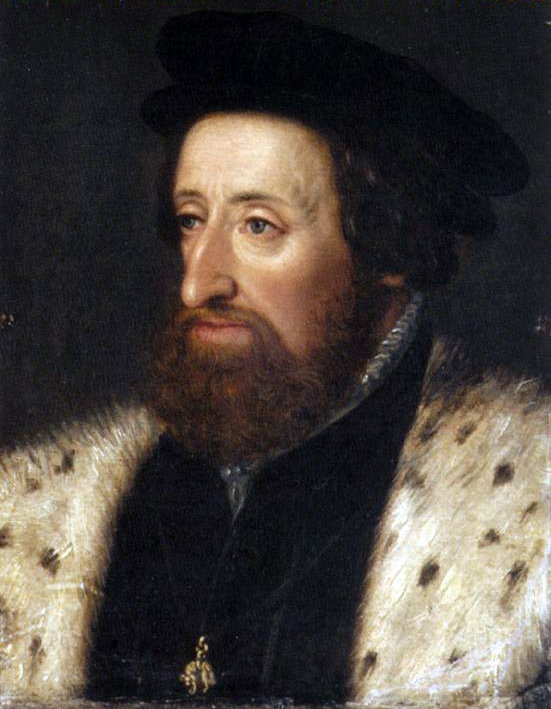
Ferdinand I
Reign
Czech Republic (1526 – 1564)
Hungary (1526 – 1564)
Germany (1531 – 1564)
Holy Roman Empire (1556 – 1564)
Description
Ferdinand I of the House of Habsburg was born on March 10, 1503 in Alcalá de Henares, near Madrid. His parents, II. Queen Johanna of Castile and King Philip I of Castile. 6 children were born from their marriage. He was separated from his mother when he was five months old, and he never saw his father until 1506, when he returned to Kastlia to take the throne. Meanwhile, King Philip was already dying. When Ferdinand's courtier heard the news, he put the city on alert to protect the little child, in case they tried to escape. After his father died in Burgos, several people came to the city and claimed him. In the end, they agreed to hand it over, so it was once again under the protection of the Kingdom of Castile. In the succession to the throne, primogeniture was in effect, so it was not Ferdinand but his oldest brother, Charles,who occupied the throne. Despite this, Ferdinand supported and helped him in everything, but Charles finally sent him out of the kingdom. Then he decided to leave his birthplace forever. In 1515, Emperor Maximilian I concluded the Habsburg-Jagiellonian marriage contract. In 1521, he married Anna Jagielló, who later bore 3 sons and 12 daughters to the Austrian archduke. In 1526, he was crowned king of Hungary in Székesfehérvár, and a few months later he also received the Czech royal rank. In the last years of his life, Charles V resigned from his post, thus giving Ferdinand the title of German-Roman Emperor, and his son Philip the territories he had ruled until now. With this, the House of Habsburg was split in two. He chose his son, Prince Maximilian, as his successor, who was crowned in 1536. He died a year later in Vienna. His motto: "Let there be justice, let the world perish!"
Minting information
Ferdinand I minted the guilder (taller) as currency in Hungary in 1553-54. Due to the two winged angel heads on the back, so-called it was also called angelic tallier. The thaler had quotients (1/2, 1/4) and multiples (2, 3, 4, sometimes 5 times). The thaler remained the currency of circulation in Hungary until 1867. In addition to silver thalers and denars, the ruler also minted money in gold. During his reign, he minted coins in several mints, in Vienna, Körmöcbány, Kassa, Konsztainica, Szeben, Nagybány, Bratislava and Szomolnok. In this age, gold forints were called ducats after the Venetian gold coins, which were the most valuable gold coins in Europe. Because of their high value, ducats were usually weighed to check for counterfeiting and circumcision.