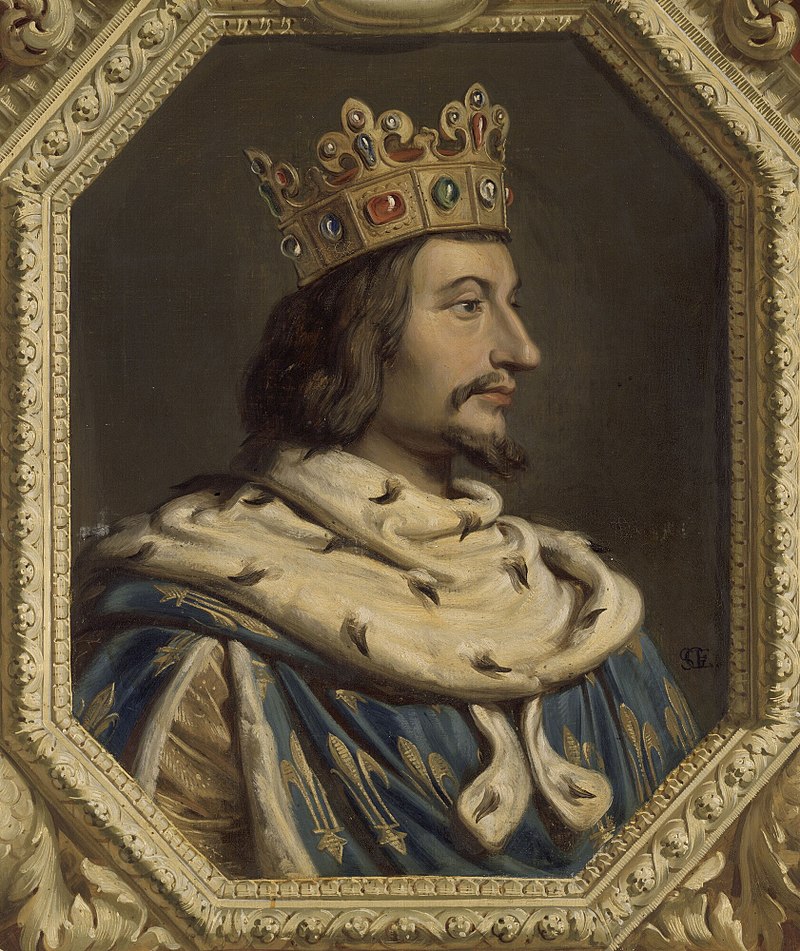
Charles V the Wise
Reign
France (1364 – 1380)
Description
Charles V was born on January 21, 1338 in Vincennes. His grandfather, VI. (Lucky) He was born in the lifetime of Philip. Since his older sister, Blanche, died as an infant, Károly became the couple's first child to reach adulthood. His siblings: Izabella of Valois, Johanna of Valois, Queen of Navarre, Mária of Valois, Duchess of Bar, II. Philip, Jean de Berry, titular King Louis I of Naples. Spouse: Queen Joan of Bourbon of France. Children: Jeanne (1357–1360), Jean (1359–1364), Bonne (1360–1360), Jean (1360–1366), Károly (1368–1422), Marie (1370–1377), Louis (1372–1407), Isabelle (1373–1378), Catherine (1378–1388). He reigned during the Hundred Years' War, a long conflict between France and England. After the Battle of Poitiers, he succeeded in strengthening the weakened and weakened French monarchy in all respects. Due to his physical abilities, he did not personally participate in the battles, but he managed to drive the English out of the continent, with the exception of a few cities. At the end of his reign, he was able to take advantage of the internal problems of the Kingdom of England and even launch a counterattack. In his last years, the island of Great Britain was hit by French sea disasters. His successor VI. Károly became V. Károly's wisdom and statesmanship contributed to the stability and successful rule of France. His resting place is in Saint-Denis Cathedral.
Minting information
King Charles V (the Wise) of France ruled from 1364 to 1380. During this period, he managed to stabilize the French financial system and significantly modernized the coinage. Károly introduced the gold franc in 1365, which became the country's official currency. The franc was made of 3.88 grams of gold, and its value was equal to 1 tour livre or 20 sols. The introduction of the franc made the French financial system more stable and contributed to the boom in trade. V. Károly made minting a state monopoly in 1364. This meant that only the royal authorities could mint money in France. The purpose of the state monopoly was to control money circulation and fight counterfeiting. Charles created new mints in France to improve the efficiency of money circulation. The new mints allowed money to be closer to bring them to users and reduce shipping costsV. Károly (the Wise)'s coinage reforms significantly contributed to the stabilization of the French financial system and the strengthening of royal power.