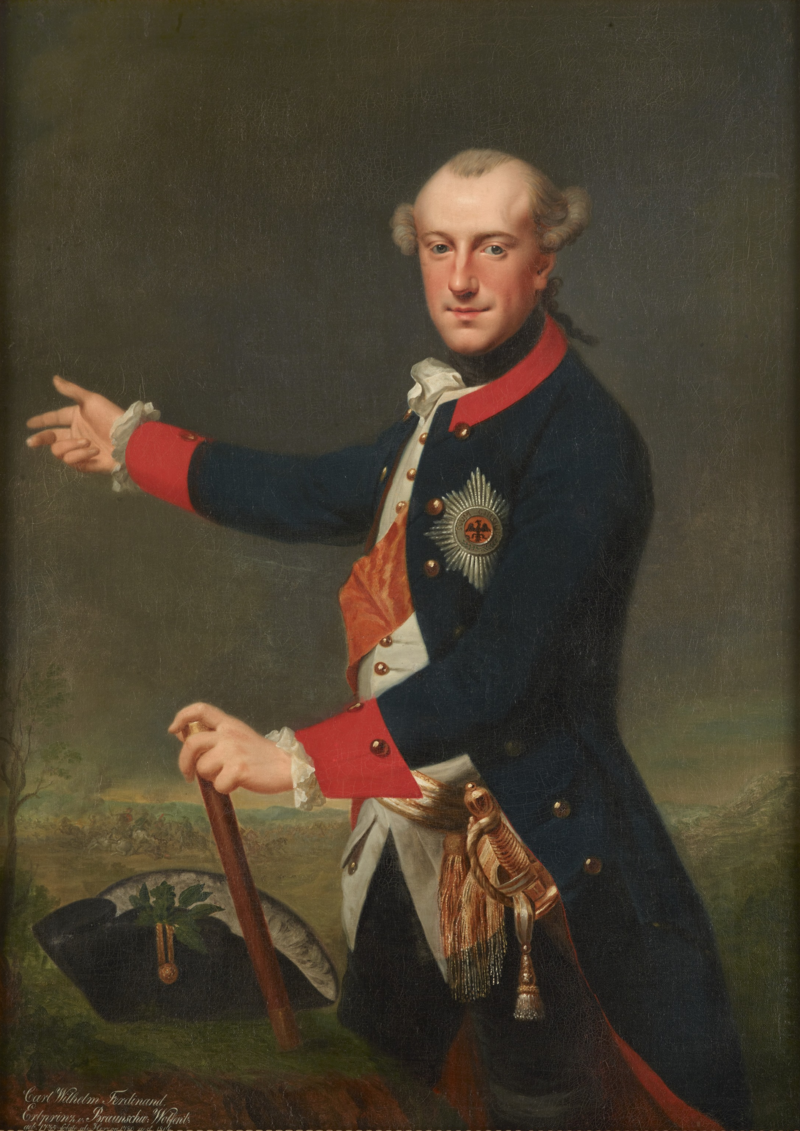
Charles II
Reign
German States Principality of Brunswick-Wolfenbüttel (1780 – 1806)
Description
II. Károly (Károly Vilmos Ferdinand) was the Prince of Braunschweig-Wolfenbüttel Károly Vilmos Ferdinand (German: Karl II. Wilhelm Ferdinand (Braunschweig-Wolfenbüttel)) was the eldest son of Prince Charles I of Braunschweig and Princess Philippine Charlotte of Prussia. (October 9, 1735 – November 10, 1806) His honors include a member of the Royal Society and the Order of St. Andrew's knee ribbon. Since 1775, he served in the Prussian army and participated in the Seven Years' War, where he defeated the French several times. In the Battle of Hastenbeck he won his first victory at the head of an infantry regiment. After the outbreak of the French Revolution, he was made commander-in-chief of the Prussian-Austrian army. He issued the famous Koblenz Manifesto, in which he threatened the republican opposition in Paris and the Jacobins with death and the complete destruction of Paris. Later, he also recaptured Mainz from the French, but due to his excessive caution, he did not take advantage of the successes and resigned from his position in 1794. In 1806, the Prussian king appointed him the head of the army again, but he was wounded in the Jena-Auerstädt battle and lost his eyesight. He died far from his homeland, in Braunschweig. His wife was Princess Augusta of Great Britain (January 16, 1764 - November 10, 1806).
Minting information
II. Prince Charles ruled from 1780 to 1806 in the Principality of Braunschweig-Wolfenbüttel of the German States. During his reign, the principality's coinage changed significantly. Before Prince Károly, the principality's coinage was conducted in a traditional way. The coins were minted in Wolfenbüttel, the capital of the duchy, and were most often made of gold, silver and copper. The motifs of the coins were the coat of arms of the duchy, the portrait of the prince and the different years. During the reign of Prince Károly, the coinage of the principality was significantly reformed. The prince renewed the coinage system following modern financial principles. Coins were then minted not only in Wolfenbüttel, but also in other cities such as Braunschweig and Halberstadt. He also changed the metals used for beating. In addition to gold, silver and copper, iron also appeared among the coins. Prince Károly's coinage reform had a significant impact on the principality's economy. Thanks to the modern financial system, the principality's money became more stable and trade also began to develop. Among the coins minted during the reign of Prince Charles, the most significant are the following: gold coins: 1 ducat, 1/2 ducat, 1/4 ducat, silver coins: 1 thaler, 1/2 thaler, 1/4 thaler, 1/8 thaler, copper coins: 1 pfennig, 2 pfennig, 3 pfennig, 4 pfennig, 5 pfennig, 10 pfennig, 20 pfennig, iron coins: 1 pfennig, 2 pfennig, 3 pfennig, 4 pfennig, 5 pfennig, 10 pfennig, 20 pfennig. All of the above coins were marked with the coat of arms of the duchy and the portrait of the prince.
