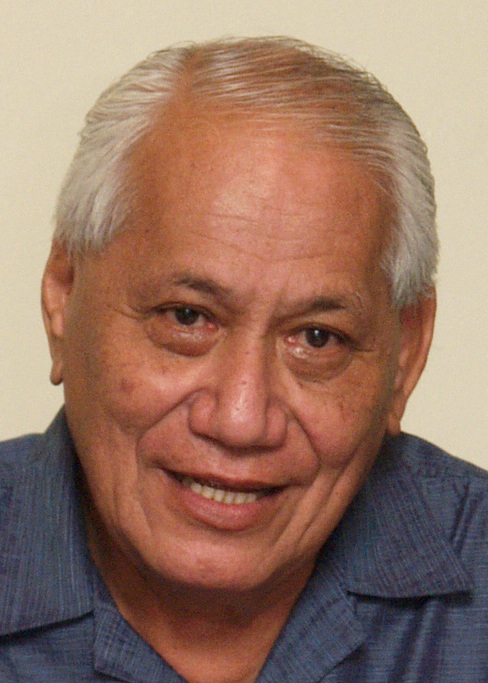
Tui Atua Tupua Tamasese Efi
Description
Tui Ātua Tupua Tamasese Tupuola Tufuga Efi (born Olaf "Efi" Tamasese; 1 March 1938) is a Samoan political leader and prominent chief, the ultimate holder of the title Tupua Tamasese. He also holds the royal pāpā title Tui Ātua ("Sovereign of Atua"). Tui Ātua was the third Prime Minister of Samoa from 1976 to 1982 and again in 1982. He was also O le Ao o le Malo (Head of State of Samoa) from 2007 to 2017. Tupua was born on March 1, 1938 in Motoʻotua, Samoa. He is the son of Samoa's first head of state (O le Ao o le Malo), Tupua Tamasese Meaʻole (1905–1963) and Irene Gustava Noue Nelson of Samoan, Swedish and British descent. Tupua attended primary school at the Marist Brothers School in Mulivai, the capital of Samoa, Apia. He continued his education at St. Patrick's College in Silverstream, Wellington, New Zealand. He also studied at the Victoria University of Wellington in New Zealand's capital. Tupua began his political career in May 1965 when he was elected to the Legislative Assembly from Vaisigano No. 1 Constituency. Between 1970 and 1972 he was the Minister of Labor of Samoa. Tupua was prime minister for two consecutive terms between 1976 and 1982. He was also Deputy Prime Minister between 1985 and 1988. During his second prime ministership, the Public Service Association went on a general strike in 1981, paralyzing the country for several months and paving the way for the opposition Human Rights Party to come to power in 1982. Tupua became the leader of the opposition after the defeat of the Christian Democratic Party in the 1982 election. He also led the Samoa National Development Party. He served as Member of Parliament for East Anoama until 2004 when he was appointed to the Samoan Council of Representatives. On May 11, 2007, II. Following the death of Malietoa Tanumafili, who had been Samoa's head of state since independence in 1962, Tupua took over as interim acting head of state alongside Tuimalealiʻifano as members of the Council of Representatives. Tupua was elected head of state on June 16, 2007. Tupua held several academic positions as a member of parliament and prime minister during and after his political career, and in 2019 he was awarded an honorary doctorate by the University of Szent András. Tupua has written three books and contributed articles to academic journals and publications. In July 2008, while attending the coronation of King George V of Tonga, he was awarded the Knight's Grand Cross and Collar of the Order of the Crown of Tonga. He received the Order of Merit of Samoa at the 2023 Samoa Honors and Awards. Tupua's wife is Masiofo Filifila Imo, also known as Masiofo Filifila Tamasese.
Minting information
Tui Atua Tupua Tamasese Efi was the prime minister of Samoa from 1976 to 1982, then the head of state from 2007 to 2017. His coinage immortalized him in both offices. Coins minted during his Prime Ministership (1976-1982, 1982): 1976: 1 tala, 2 tala, 5 tala (with the portrait of Queen Elizabeth II) 1978: 1 sene, 2 sene, 5 sene, 10 sene, 20 sene, 50 sene (with the portrait of Queen Elizabeth II) Banknotes: 1978: 1 tala, 2 tala, 5 tala, 10 tala (with the portrait of Queen Elizabeth II) Coins and banknotes issued in the capacity of the Office of the Head of State (2007-2017): 2008: 1 tala . , 20 tala (with portrait of Tui Atua Tupua Tamasese Efi) Coins of 1976 and banknotes of 1978 II. They feature a portrait of Queen Elizabeth with the coat of arms of Samoa on the reverse. The 1978 coins depict Samoan motifs such as the fale (bread tree) and the kava plant. The 2008 and 2011 coins feature the portrait of Tui Atua Tupua Tamasese Efi with the coat of arms of Samoa on the reverse. The 2010 banknotes depict the portrait of Tui Atua Tupua Tamasese Efi with Samoan landscapes and cultural motifs on the reverse. Commemorative medals were also issued in honor of Tui Atua Tupua Tamasese Efi in 2007 on the occasion of his 60th birthday and in 2017 on his 10th birthday. on the occasion of the anniversary of his election as head of state. Tui Atua Tupua Tamasese Efi was one of the most decisive figures in the history of Samoa. Its coinage in both offices reflects Samoan identity and culture.

