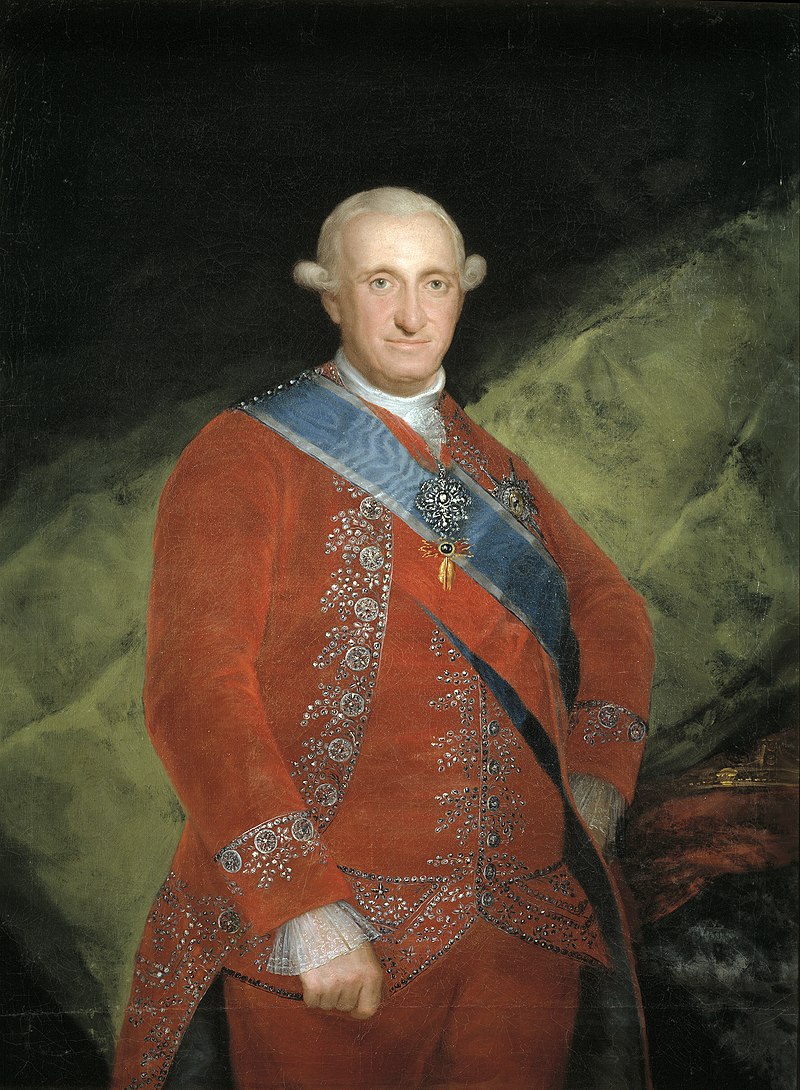
Charles IV
Description
ARC. Charles (Spanish: Carlos IV de España; Portici, November 11, 1748 – Rome, January 20, 1819), Spanish infant from the House of Bourbon, Prince of Asturias, who succeeded his father as King of Spain from 1788 to 1808, until the war of independence against the French invasion, when his son, the future VII, was forced to resign. in favor of Ferdinand IV. Károly was born on November 11, 1748 in Portici as the seventh child of his parents. He was a half-orphan from the age of twelve, because his mother died at the age of thirty-six. His father was VIII. of the House of Bourbon. Károly, King of Naples, King of Sicily under the name Károly V, the later III. He was King Charles of Spain (1716–1788), the son of King Philip V of Spain (1683–1746) and Princess Elizabeth Farnese of Parma (1692–1766). His mother was Princess Mária Amália Krisztina of Saxony, Royal Princess of Poland (1724– 1760) was, III. Daughter of King August of Poland (Elector August August of Saxony, 1696–1763) and Archduchess Mária Jozefa of Habsburg (1699–1757), Queen of Naples and Sicily, then of Spain (Reina María Amalia de Sajonia). When in 1759 VI. Due to Ferdinand's death, the Spanish throne became vacant, and his father abdicated Naples-Sicily to his second-born son, IV. In favor of Ferdinand, the 11-year-old Károly moved with his family to Madrid, where he received the title of Duke of Asturias, the heir to the Spanish throne, from his father in the same year. He got married in 1765 at the age of seventeen, marrying his first cousin, the 13-year-old Princess Mária Lujza of Bourbon-Parma, the daughter of his paternal uncle, Prince Fílöp of Bourbon-Parma. A total of fourteen children were born from the relationship between the two of them, seven of whom reached adulthood. 1788. on December 14, his father passed away. At the age of forty, IV. He ascended the throne of Spain under the name Charles. During his reign, the actual power was in the hands of the court chamberlain, his wife, Queen Mária Lujza, and his patron, Prime Minister Manuel Godoy. As a result of the French Revolution, Károly withdrew his father's reforms and waged a war against revolutionary France between 1793 and 1795, which ended in failure. His country was forced into an alliance with Napoleonic France and had to participate in its wars, as a result of which it completely lost its independence. A popular uprising broke out in 1808 against the French occupation that began in 1807. As a result, on March 17, 1808, Károly abdicated his son, the later VII. In favor of Ferdinand. Charles then fled with his wife to France, where he was forced to withdraw his abdication in favor of his son and abdicate again in favor of Napoleon's brother Joseph Bonaparte. The royal family was taken into "protective custody" by the French. VII, who opposed Napoleon. Ferdinand became a symbol of resistance and independence against his father IV. With Károl, who was considered a French collaborator. IV. Károly spent his last years in Rome, where he also died a few days after the death of his wife, on January 20, 1819. He was buried in the traditional burial place of the Spanish Bourbons, in the royal monastery of San Lorenzo de El Escorial in Madrid.
Minting information
ARC. Károly II, who is also known in Spain. As Charles, he ruled Spain and Mexico between 1788 and 1808. His coinage brought significant changes to Spanish and Mexican coinage. Spanish silver reals and gold escudos remained largely unchanged, but due to numerous foreign wars and political instability, the financial system became unstable. IV. Károly was minted in several mints of the Spanish empire, including the Mexican mint. The Spanish monetary system was based on reales, which were coins made of silver. The most valuable coin was the 8 reales, often called the dollar or the peso. IV. Károly's coins show the portrait and coat of arms of the king, as well as the mint mark and year of minting. The Mexican mint mark was the letter M. The coat of arms of the Spanish Empire and the password PLUS ULTRA (Further) could be read on the back of the coins. IV. Charles' coins also spread outside the territory of the Spanish Empire, especially in North and South America, where they were used by Spanish colonies and independent states. The first US dollar was modeled after the Spanish 8 reales coin in 1794.
