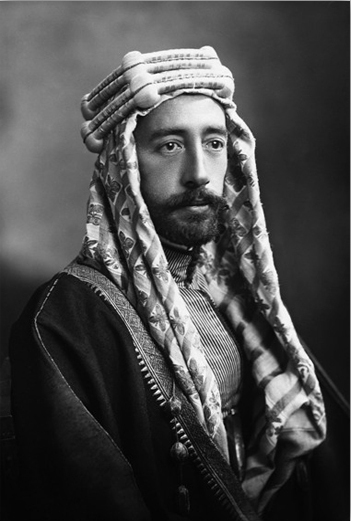
Faisal I
Description
I. Fejsál, whose full name was Faysal ibn Husayn ibn Ali al-Hashimi, was the third son of Husayn, Sherif of Mecca. He acted as an Arab emir and national leader, for a short time he was the ruler of Greater Syria and then the king of Iraq from 1921 to 1933. Fejsál was born in the city of Taif in present-day Saudi Arabia, near Mecca. In 1913, he represented his homeland in the Ottoman parliament as an elected representative. In 1916, he visited the city of Damascus twice and declared his commitment to the Arab national cause, which meant the overthrow of Turkish rule and the declaration of an independent Arab state(s) in the Middle East. was standing He became the leader of an Arab national uprising organized with the help of TE Lawrence, and after a long siege, he captured Medina, which was protected by the Ottoman governor, Fahri Pasha. With the Arab national uprising, he significantly supported the anti-Turkish efforts of the Entente and the liberation of Greater Syria from the rule of the sultans. In 1918, he entered Damascus, where he played a key role in the creation of the provisional Arab civil government. He led the Arab delegation at the Paris peace talks in 1919. Fejsál became the king of Syria in 1920, but his reign was short-lived as he was ousted from power by French troops. However, in 1921, with British support, he was crowned king of Iraq, where he ruled until his death in 1933. As king, Fejszál launched modernization efforts and worked for the country's independence. Fejszál died on September 8, 1933 in Bern, Switzerland, and was laid to rest in Baghdad. During his reign, Iraq underwent significant changes, and the beginning of the country's modernization can be attributed to him. The memory of King Fejsál is still respected in Iraq.
Minting information
King Fejsál I of Iraq and Syria ruled from 1921 to 1933. During this period, several types of coins were minted in Iraq and Syria, all of which depicted the portrait of King Fejsál. In Iraq, the first Fejsál coins were produced in 1921. These were silver and copper coins with the king's portrait as well as the coat of arms of Iraq. In 1923, the Iraqi dinar was introduced, replacing all other currencies in the following years. The dinar is made of silver, copper and aluminum. In Syria, the first Fejsál coins were made in 1925. These were silver and copper coins, which bore the coat of arms of Syria in addition to the portrait of the king. In 1927, the Syrian pound was introduced, which replaced all other currencies in the following years. The pound is made of silver, copper and aluminum. King Fejsál's coins are important historical documents that reflect the independence and development of the two countries. King Fejsál's coins are still in commercial circulation today and are valuable collector's items.


