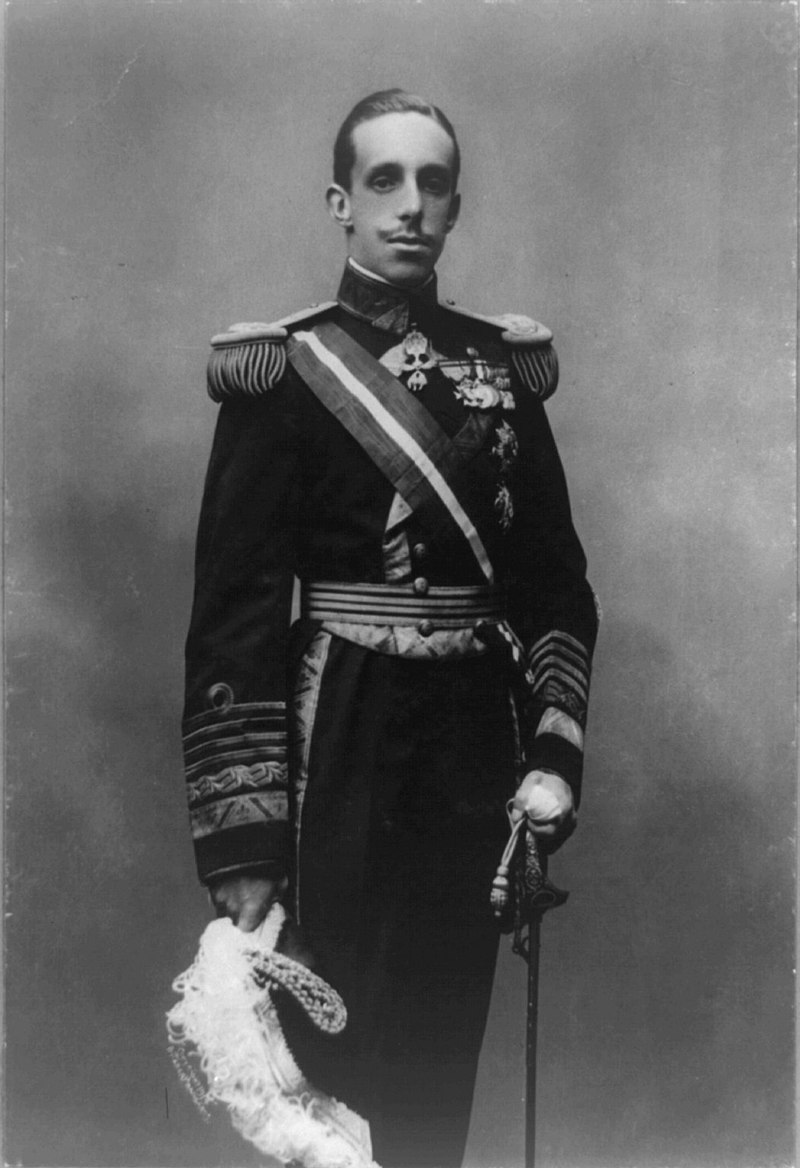
Alfonso XIII
Description
Alfonso XIII was born in 1886 as the only son of King AlfonsoXII of Spain and Maria Christina of Austria.
Alfonso was king from birth. His father suffered from lung disease and died before his son was born. His widow immediately took over the regency in the name of their daughter, the infant Mária de las Mercedes, who had not yet been officially proclaimed ruler. Alfonso was born in 1886 and he was immediately appointed king. This way, her sister did not become queen, but only heir to the throne until her death in 1904.
Alfonso's XIII grandmother, the dethroned at that time, Queen Isabella II took it as a bad name that not she, but her daughter-in-law, Queen Christina Mária Tescheni of Spain, was appointed regent. She led the country for 17 years, after which she handed over power to her then-adult son, Alfonso.
In 1906, he married the British Queen Victoria's granddaughter, Victoria Eugenia, with whom they had 6 children.
He was nominated for the Nobel Peace Prize, which was eventually won by the Red Cross. To this day, he is the only monarch in history who was nominated for the Nobel Prize.
In 1931, he left the country without resigning and the republic was proclaimed on the same day, which he also lived through the fall of 1939. His grandson Juan Carlos succeeded him on the throne.
Minting information
XIII. King Alfonso of Spain ascended the throne in 1902 and reigned until 1931. During this time, many changes took place in Spanish coinage. In 1902, the Spanish peseta replaced the old Spanish copper coin. The new peseta was based on gold and consisted of 100 centavos. In 1907, new coins were minted, on which XIII. It was a portrait of King Alphonsus. The value of the coins was 1, 5, 10, 25 and 50 centavos. In 1910, new banknotes were minted, which also date back to the XIII. A portrait of King Alphonsus was depicted. The value of the banknotes was 5, 10, 25, 50, 100, 500 and 1000 pesetas. In 1925, the Spanish government introduced banknotes due to economic difficulties. The value of the banknotes was 5, 10, 25, 50, 100, 500 and 1000 pesetas. In 1931 XIII. King Alfonso abdicated and the Second Spanish Republic was established. During the republic, there were no significant changes in the Spanish coinage. XIII. The coinage of King Alfonso was an important milestone in Spanish monetary history. The new coins and notes were considered more modern and attractive than the previous ones. The introduction of banknotes was an important step towards the modernization of the Spanish economy.
Spain Alfonso XIII (1886-1931) 5 Pesetas .900 Silver Coin
Available: 1 pcs (1 seller)
29 300 Ft

Philippines Alfonso XIII 1 Piso .900 Silver Coin

Spain Alfonso XIII (1886-1931) 5 Pesetas .900 Silver Coin

Spain Alfonso XIII (1886-1931) 25 Centimos Coin

Spain Alfonso XIII (1886-1931) 1 Centimos Coin
Spain Alfonso XIII (1886-1931) 50 Centimos .835 Silver Coin
Spain Alfonso XIII (1886-1931) 5 Pesetas .900 Silver Coin