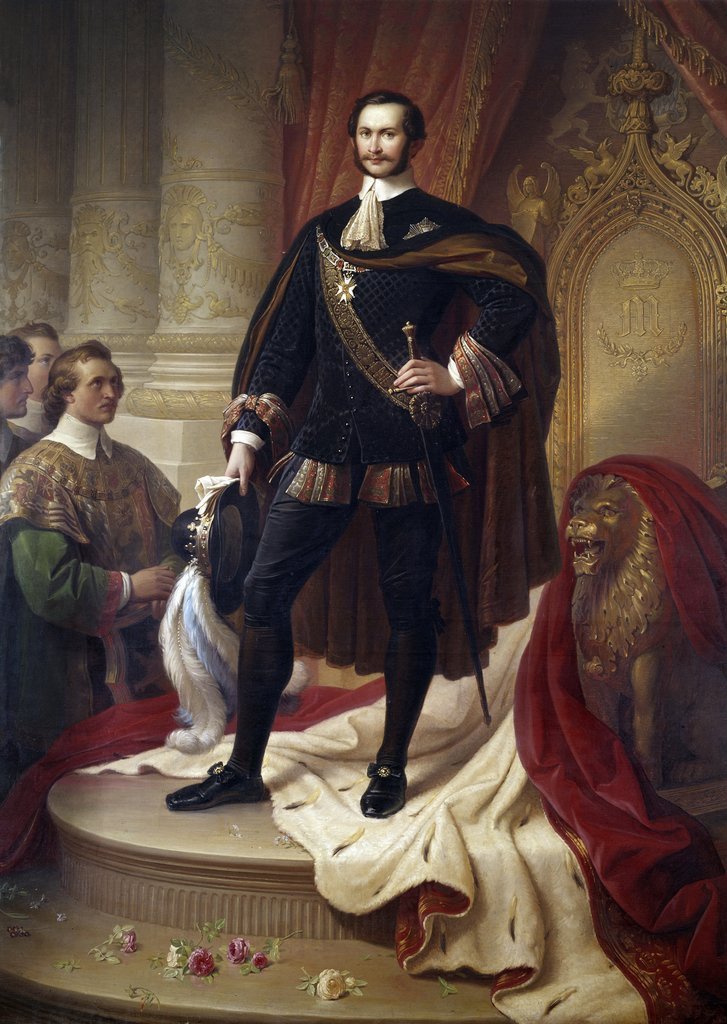
Maximilian II Joseph
Reign
German States Bavaria (1848 – 1864)
Description
II. Miksa (full name Miksa József) was a Bavarian royal prince from the Wittelsbach house. I. He was born as the eldest child of King Louis of Bavaria and his wife, Princess Terézia Sarolta of Saxe-Hildburghausen, and her parents had a total of 9 children. He became the third king of Bavaria from the abdication of his father, King Louis I of Bavaria, in 1848 until his death in 1864. Miksa tried to create a "third force" in German politics, which would have meant an alliance of smaller states led by Bavaria. Unfortunately, his plan failed due to Austrian, Prussian and German resistance. Miksa, like his predecessors, had the flourishing of culture at heart. His resting place is in the Church of the Theatines in Munich. On October 12, 1842, Miksa married the Prussian Princess Mária Friderika of the House of Hohenzollern, the daughter of the Prussian Prince Vilmos III. The niece of King Frederick William of Prussia. Two sons were born from the marriage, both became kings of the Bavarians, but both were overcome by mental illness: Lajos (1845–1886, ruled as Lajos II between 1864–1886).Ottó (1848–1916, ruled between 1886–1913. Named after his uncle , ruled by Regent Luitpold).
Minting information
II. King József Miksa, who was the ruler of Bavaria from 1848 to 1864, paid a lot of attention to finance and coinage. In 1848, he introduced the Bavarian gold kilo, which had a fineness of 900/1000. This decision significantly improved the quality of Bavarian gold bars and coins and contributed to the stabilization of the Bavarian economy. In 1855, he established the Bayerische Notenbank, the predecessor of today's German National Bank. The task of the bank was to issue the Bavarian currency and ensure the financial stability of the economy.II. Among King Miksa's coins, the most significant are the 10 and 20 HUF gold coins minted in 1857 and 1858. These coins are of excellent quality and are considered one of the most beautiful Bavarian coins.II. The financial policy of King József Miksa contributed to the development of the Bavarian economy and the strengthening of the Bavarian state.

German States Bavaria Maximilian II Joseph (1848-1864) .900 Silver 2 Gulden
Available: 1 pcs (1 seller)
38 500 Ft

German States Bavaria Maximilian II (1848-1864) 1 Krauzer Coin
German States Bavaria Maximilian II (1848-1864) 1 Heller Coin
German States Bavaria Maximilian II (1848-1864) 2 Pfennige Coin